

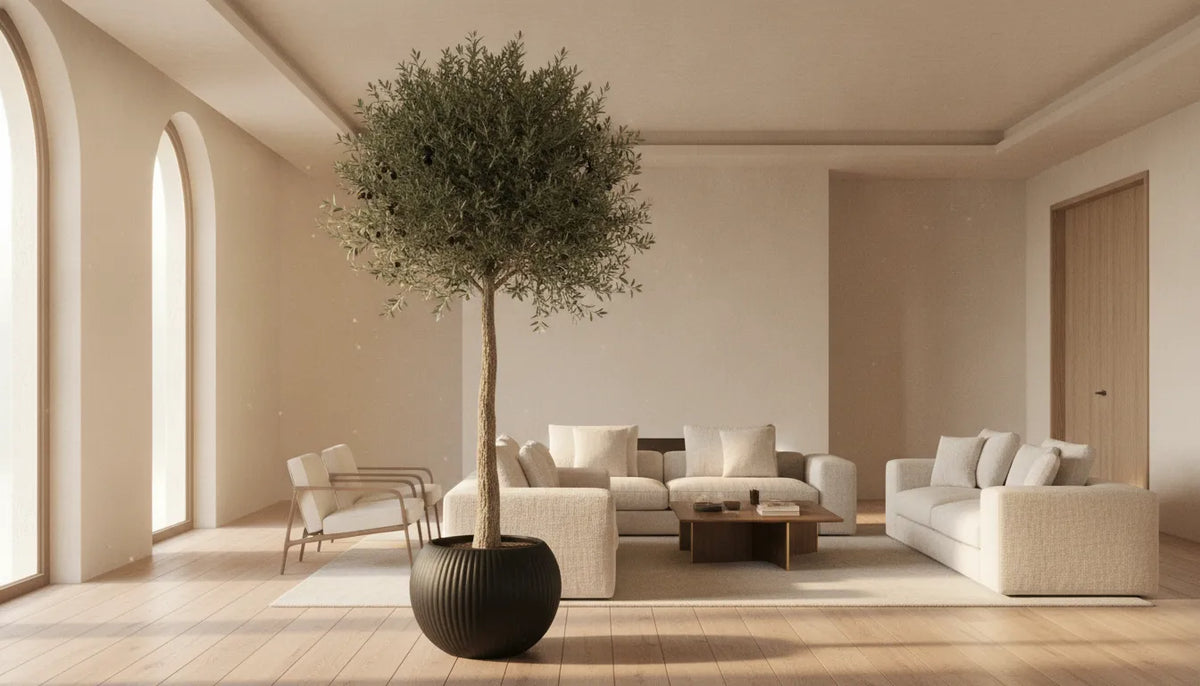
Are luxury artificial plants worth it when the room is already finished and still feels cold? The honest answer is a room test, not a promise. A permanent botanical earns its place when the species, scale, vessel, and light read as part of the architecture. The piece belongs when it holds the room's axis. Jardin Du Monde builds that decision around catalog pieces and a design consultation, not around a return figure.
Call the concierge at (727) 433-8834 if you already know the room and want a designer to look at the sightline.
This guide is for a designer or a homeowner who has invested in the room. It walks the test in order: what the eye accepts, how the piece meets the architecture, and how to care for it. Then it covers the live catalog, plus what delivery and creation time add to the project. It does not rank products, and it does not claim a piece will last a set number of years.
Are Luxury Artificial Plants Worth It in a Finished Room?
Start at the threshold, not at the product photo. If a guest can name the piece as decoration before they feel the room, the purchase is early. Worth, in this house, means the botanical holds the axis of the space the way stone, linen, and aged wood already do.
Jardin Du Monde is a luxury botanical art design house. The work is permanent botanical art for elevated residences, and for hotels, yachts, aviation, and executive offices as named markets. Founder Mary Kate Siuba built the house around composition. Two paths exist. You buy a configured piece from the Shopify catalog, or you request a design consultation that leads to a room-specific proposal.
The test has six checks. Pause the order if one fails.
- The species belongs to the room's climate of materials, not to a trend board.
- The height and canopy clear the architecture without crowding the ceiling or the path.
- The vessel finish already lives in the room, in metal, stone, or a quiet matte.
- The light at that spot will show the foliage, not hide it.
- You know how the piece is dusted, and you accept that lifespan is not published as a year count.
- You can name the catalog piece, the delivery path, and the creation time before you pay.
Daily care and lifespan belong in that test, beside scale and light. They do not replace it. The purchase still turns on whether the piece belongs in the room you already have.
Read Realism at the Sightline, Not in the Product Photo
A product photo is a controlled light. The room is not. Stand where a guest actually pauses: the entry, the end of a sofa, the chair across a desk. If the canopy looks flat from that point, a closer photo will not save it.
Look for variation, not shine. Silvery-green olive foliage should shift from one leaf to the next. A trunk should show texture, not a uniform tube. Clusters of fruit or flower should sit inside the canopy, not float on the surface. Handcrafted pieces vary. The Mediterranean Olive Tree page says actual foliage shape may vary because the piece is handcrafted. That variation is part of the object. A perfectly repeated leaf is the tell.
Color has to survive the room's own palette. Limestone, oak, linen, and leather ask for a quiet green. A saturated leaf that looked rich online can read as costume against pale stone. If you are specifying for a client, photograph the corner in the light you will keep, then hold the product image beside it. Do not trust a white studio background.
What a designer should reject on sight
Reject a uniform plastic sheen, a trunk with no bark break, and a canopy that is the same density on every side. Also reject a vessel that shouts. A ribbed matte noir or matte blanc can disappear into the architecture. A glossy novelty pot cannot. Jardin Du Monde sells trees with vessel, texture, and size selectors, so the vessel is part of the piece, not an afterthought.
This section only asks whether the piece passes the sightline you already have. The broader method for choosing a piece is a separate decision, once this test says the room is ready.
Match Scale, Vessel, Species, and Light to the Architecture
Scale is the first design decision, and it is measurable. The Mediterranean Olive Tree is offered at 8 feet, 96 inches high by 60 inches wide and deep, and at 9 feet, 108 inches high with the same 60-inch spread. That canopy needs a clear circle on the floor and air above the dome. A 9-foot tree under a low beam is a collision with the ceiling, not a statement.
Measure three things before you fall in love with a height. Measure floor to the lowest beam or pendant. Measure the clear width of the path around the vessel. Measure the doorway, stair, and elevator the piece must pass. The shipping policy asks you to confirm that the item fits through doorways, stairs, halls, elevators, and corners. A beautiful tree that cannot enter the room is a poor order.
Species and the job of the corner
Trees carry height and hold an axis. Florals soften a table or a console. Grasses lighten a long planter. Succulents belong on a smaller surface where a tree would overwhelm. The catalog is organized in those families. Start with the tree collection when the room needs height, and with the floral collection when the job is a table or a console. Pick the family that matches the job, then the piece.
Light is the quiet check. Side light from a tall window, as in a pale living room, shows trunk texture and leaf variation. A dark corner hides both, so a tall tree there spends its presence on a silhouette only. The house does not publish one sunlight rule for the whole catalog. Outdoor and UV claims stay on the product page. The olive tree is labeled UV resistant and still names interior settings: residences, hospitality, executive rooms, yachts, and aviation. Do not treat that label as a blanket outdoor rating.
The vessel should already agree with the room. On the olive tree, the style choices are circular, triangled, or square, in matte noir, matte blanc, ribbed noir, or ribbed blanc. A circular ribbed noir vessel reads as sculpture beside linen. A square matte blanc vessel reads quieter against pale stone. Choose the one the architecture already suggests.
Care for the Piece, and Leave Lifespan Uncounted
Care is part of the purchase, and it is simpler than a living plant's calendar. Dust the canopy and the trunk on the same rhythm you dust the console and the stone. A soft cloth keeps leaf variation visible. A dark, dusty corner will hide the trunk texture you paid to see. The house does not publish one cleaning product for the whole catalog, so follow the product page for the piece you buy and keep liquids off the vessel finish.
What the catalog does not document is a year count. No page on this site states that a botanical lasts a set number of years, indoors or out. Longevity, in this test, means the piece keeps its silhouette without watering, pruning, or seasonal replacement. It does not mean a warranty of decades. If a product page is silent on lifespan, leave the claim out of the specification.
Placement protects the piece you already chose. Keep it clear of a heat register and of a path where a bag or a chair will crush the lower foliage. Outdoor use stays on the SKU. A UV-resistant label on the olive tree is that product's note, not a catalog-wide outdoor rating, and it is not a marine or fire certification. Care well, and still treat lifespan as unpublished.
Price the Piece You Can Configure, Then the Delivery
Worth includes money, but only the money you can see on a live page. A collection tile that says "from" is a starting price. The configured total, with size and finish, is what you pay. Shipping is calculated in the path the policy names, not as a free add-on.
On 14 November 2026, the Mediterranean Olive Tree listed at $2,000 before tax and delivery. That page is one piece. It is not a catalog average, and it is not a fee. Smaller floral pieces and larger palms sit at other prices. Read the product page for the piece you mean. Do not borrow this figure for a different tree.
| Project input | What the live page states | What it does not state |
|---|---|---|
| Catalog tree example | The Mediterranean Olive Tree lists at $2,000, in an 8-foot or 9-foot size, with vessel style and texture choices. | There is no single price for every tree, and no configured total before you select options. |
| Creation time | This handcrafted olive tree needs two to four weeks before shipment. | There is no promise that every piece shares that lead time. |
| White-glove delivery | Local is $299, extended is $399, national is $599, and Alaska or Hawaii is $1,699, on applicable products to one address. | There is no map of which ZIP codes are local, extended, or national. |
| Standard carrier | Items outside Unlimited Delivery ship by the carrier network. Read the live shipping policy for the current rate and window. | This guide does not restate a day count or a dollar band for that path. Freight over 150 pounds has its own notes. |
| Design consultation | It can be virtual or in person, and it leads to a room-specific proposal. Pricing, geography, timing, delivery, and installation are confirmed case by case. | The public page leaves project-specific service terms to the consultation. |
White-glove rates apply in the policy's Unlimited Delivery, including Tampa, Saint Petersburg, and Sarasota ZIP codes on applicable products. Oversized, very heavy, or fragile items can add a surcharge. The policy does not publish the surcharge amount, so ask before you treat $599 as the full national cost of a tall tree.
Standard delivery is the other path. The live shipping policy sets that rate from merchandise value and names the arrival window there. This article does not reprint those bands or a day count, because the published window and the house record do not agree. Express is a separate, faster option on eligible orders received by noon Eastern, Monday through Friday, and it is not offered on every item. A free-shipping line in a cart is not an offer until checkout confirms it.
Direct shipping covers the United States and Canada. The house does not ship to U.S. territories, including Guam, Puerto Rico, and the U.S. Virgin Islands. Confirm the delivery path for your address before ordering. Returns of orders outside the United States are not part of the refund path.
Count Creation Time, Returns, and the Consultation Path
A finished room often has a date: a photoshoot, a guest arrival, a board meeting. Lead time is part of worth. The olive tree asks for two to four weeks of creation before shipment. Transit comes after that. White-glove scheduling starts when the goods are ready, and the policy asks you to take receipt within 15 days. Build the calendar from creation, then transit, then the delivery window. Do not build it from a product photo.
Ordinary returns need contact within 30 days of delivery, with proof of purchase, for items still in as-new condition. Installed items are excluded. Special orders take a nonrefundable 50 percent deposit and cannot be cancelled or returned. A catalog tree with published size and finish choices is not automatically a special order. Confirm the classification with the house before you assume you can send it back. Delivery fees are not refunded except for a manufacturer defect or transit damage.
The second commercial path is the consultation. Concierge hours are Monday through Friday, 9:00 to 5:00 Eastern. The published number is (727) 433-8834. A consultation can be virtual or in person. It looks at architecture, light, and the way you want the room to feel, then proposes species, silhouette, vessel, and scale. On-site styling and delivery are upon request. They are not included in every purchase. Project-specific service terms are confirmed with the house. Ask the concierge whether the project fits a design conversation before you book.
Use the consultation when the room has more than one piece, when a tree must clear a stair, or when photos are not enough to choose. Use the catalog when one configured piece already passes the six checks. The personal consultation page states the sequence, so this section only places that meeting inside the buying decision.
When the room needs a proposal beyond a single catalog piece, book a private consultation and bring the measurements, the light, and the deadline.
Frequently Asked Questions
Is a luxury botanical worth buying in a room you rarely use?
Often yes, if the piece is specified for that room and you accept the catalog price plus delivery. A vacation home, a yacht cabin, or a boardroom that must look composed on arrival is a strong case for permanent botanical art. The piece still has to pass scale, vessel, light, and care. An unused room is not a reason to hide a weak canopy in a dark corner.
Does a higher price mean the piece will look real?
No. Price is not a realism guarantee. Judge the trunk, the leaf variation, and the vessel from the sightline you will actually use. The Mediterranean Olive Tree at $2,000 is a specific 8-foot or 9-foot composition with stated vessel choices. Another price on another page is a different object. Read that page before you treat price as proof.
Can I place a luxury botanical outdoors?
Only when that product page says so. The olive tree is labeled UV resistant and is presented for interior settings, including residences, hospitality, offices, yachts, and aviation. That is not a catalog-wide outdoor or marine rating. If the page does not state a certification, the house is not claiming one.
How should I care for it, and how long will it last?
Dust the foliage and the trunk the way you dust the rest of the room, and keep the piece off a heat register and out of a crushed path. The catalog does not publish a year count for lifespan. Treat longevity as the absence of watering and seasonal replacement, not as a dated guarantee. Confirm any care note on the product page for the SKU you order.
How long should I allow before the piece arrives?
For the Mediterranean Olive Tree, allow two to four weeks of creation before shipment, then the delivery window on the shipping policy. White-glove delivery is scheduled once the goods are ready, and you are asked to take receipt within 15 days. Confirm the lead time on the SKU you order. Do not apply the olive tree's weeks to a small floral.
Should I buy from the catalog or book a consultation?
Buy from the catalog when one configured piece already fits the architecture and you can confirm delivery access. Book a consultation when the room needs a proposal across species, vessels, and sightlines, or when styling on site is part of the request. Consultations can be virtual or in person. The public site does not publish a consultation fee. Ask the concierge whether the project is a fit before you book.
Decide on the Room, Then the Piece
A luxury botanical is worth the purchase when it holds the room. That means the right species, a canopy that clears the architecture, a vessel the materials already accept, a care habit you will keep, and a delivery path you have read on the live policy. It is a poor purchase when the only goal is to fill a corner with something green.
Jardin Du Monde will sell you the configured piece, or sit with the room and write a proposal. Bring the height, the path in, the light, and the date. Leave the trend board at the door.
Call the concierge at (727) 433-8834, weekdays 9:00 to 5:00 Eastern, or start from the contact page if a written note is the better path for your studio. Returns follow the refund policy, including the 30-day window for eligible items.


