

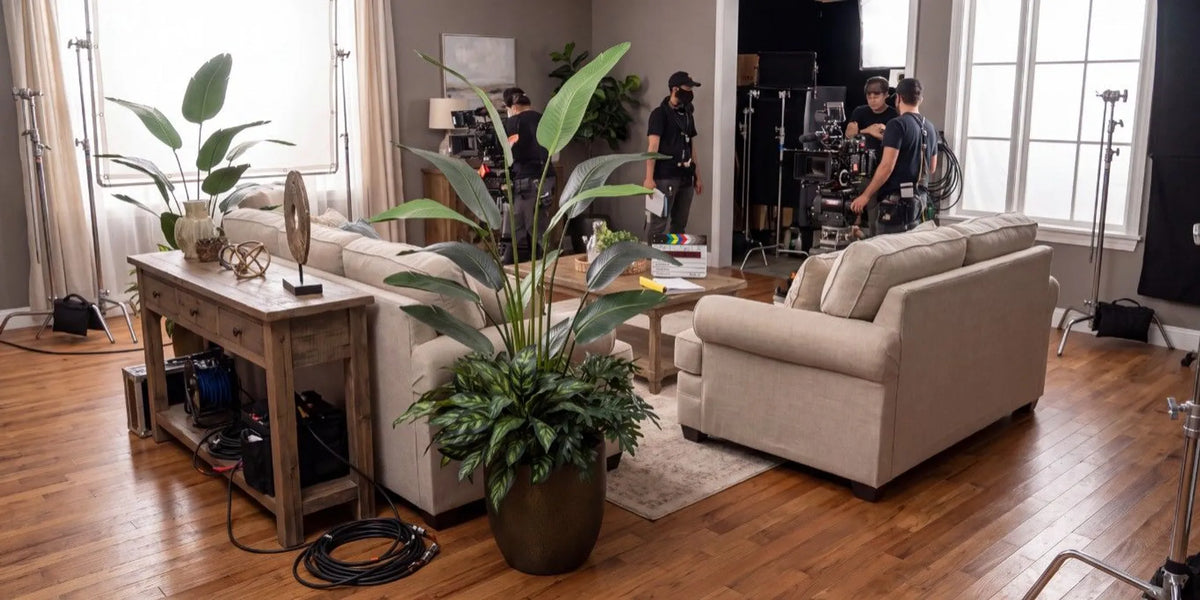
A furnished set can still feel unfinished on camera. Artificial plants for film set design give the room scale, age, and atmosphere without asking a living plant to hold its shape through a long day. Begin with the architecture and the camera plan, then shape the botanical detail around the story the room has to tell.
Call (727) 433-8834 to discuss a room-specific botanical composition
Why use artificial plants for film set design?
On screen, a plant is never only a plant. Scale can make a room feel grand or intimate. A silhouette can soften a hard line or point the eye toward the part of the set that matters. A vessel can suggest taste, age, or a relationship to the outdoors. The composition joins the room's visual language even when it fills only part of the frame.
That does not mean every scene needs a tree. A single stem, a low planter, or one sculptural form may say more. The right choice depends on what the room should express: calm, ceremony, lived-in warmth, or a precise sense of place. Write that intention in one plain sentence before anyone shops.
For a room that is not a set, artificial plants in Tampa, FL follow the same room-first idea: architecture, light, palette, and how the space should feel. A film set adds one more test. The composition has to survive the lens, the lighting plan, and a reset between takes.
Set designers, art directors, and decorators can use this guide as a repeatable review. It covers camera-facing placement, scale, vessels, realistic detail, light, and continuity. It does not imply that Jardin Du Monde has dressed a film or a television production.
Begin with the scene, not the species
Read the scene as a complete room before you choose a form. Note the architecture, the design language, the palette, the furniture scale, the practical light, and the emotional temperature. Then ask what the room needs botanically. That order keeps the composition tied to the set instead of treating it as a last flourish.
A useful atmosphere note is short. A formal salon might feel composed, with a quiet sense of age. A sunlit apartment might feel collected and close to a garden. These are working descriptions, not rules. They give the art department one shared reference.
- Architecture: Ceiling height, window proportions, wall detail, and the strong vertical or horizontal lines.
- Furniture: Height and visual weight of the seating, tables, and objects that share the frame.
- Atmosphere: A few precise words, such as serene, ceremonial, intimate, or urbane.
- Story: What the room reveals about its occupant, and what should stay visually quiet.
Keep the note visible as the set develops. If a botanical element cannot connect to the architecture, the atmosphere, or the story, reconsider it before it is placed.
Map the frame before you place anything
A room plan is not a camera plan. A composition that looks balanced in person can read as crowded, cropped, or detached from the lens. Review shot sizes, camera height, lens direction, and actor movement. Mark the views that matter most, and keep the placement flexible until the framing is understood.
For each principal setup, note which walls, corners, and surfaces enter the frame. A piece at the edge of one shot may sit behind a performer in another. Look through a monitor or viewfinder, and judge the composition from the camera's actual position.
- Label each camera position and the setup it serves.
- Mark the footprint and the approximate visible height.
- Say whether it sits in the foreground, middle ground, or background.
- Flag doors, walkways, and furniture moves that must stay clear.
- Save a camera-facing still once the composition is approved.
When angles are still changing, test the space with a temporary marker of similar size. Treat that test as a framing aid, not as proof the finished piece will look the same. Confirm the real silhouette and vessel when the chosen piece is on set.
Set scale against the whole frame
Height alone does not describe how a piece will read. Width, canopy shape, branch direction, leaf density, and the open wall around it all change the visual weight. A tall narrow form can draw the eye through a frame. A broad canopy can fill it. A low arrangement can ground a table or hide a designed surface.
Record practical measurements before you propose a piece: ceiling height, floor area, vessel footprint, and the frame's visible edges. Include nearby console heights, chair backs, and window sills. Near a doorway, capture the clearance people and equipment need.
For a wide shot, relate the silhouette to the room's major lines. For a medium shot, check whether leaves outline a face or cross a key prop. For a close view, look at leaf shape, branch junctions, and vessel finish. Judge the piece at the shot sizes where it will appear.
| Shot | What to judge | What to write down |
|---|---|---|
| Wide shot. | Judge the silhouette against architecture and open space. | Note how high the form may rise. |
| Medium shot. | Judge overlap with faces, furniture, and props. | Note the clear zone beside the performer. |
| Close shot. | Judge leaf edges, joins, and the vessel finish. | Note which details the lens will resolve. |
| Moving shot. | Judge how the form changes as the camera travels. | Note the path that must stay clear. |
Think of scale as a sequence: room, furniture, botanical form, vessel, then crop. A useful note might say, "Keep the upper silhouette below the cornice in the wide. Leave clear space beside the window. Let the vessel anchor the console." Specific notes stay usable when a piece has to shift during the day.
Give the camera a deliberate face
Most compositions have a side that presents their shape most clearly. Find that camera-facing side and mark an orientation the crew can restore. Rotate the piece in small steps while you watch the frame. The view that feels natural in the room may not show the same depth from the lens.
Look at the outline against the background. Leaves can vanish against a similar curtain, merge into a dark cabinet, or turn busy against a pattern. A small shift may create cleaner separation. Stay faithful to the room. Do not turn a quiet composition into a distraction just to show every leaf.
Check overlaps. A branch that seems to grow from a lamp, a chair, or a head becomes an accidental joke. The same risk applies to frames, door jambs, and moldings. If a performer moves through the shot, rehearse that path and confirm the form stays in the intended relationship.
A facing note should say what the frame needs. Show the branch rhythm on the pale wall, keep the vessel edge visible, and leave the painting's lower corner clear. That instruction is observable, and another person can repeat it.
Choose character with the setting in mind
Leaf shape, branching, and overall form carry associations. A disciplined tree can lend order to a formal interior. A flowering branch can bring softness. A grass-like composition can suggest movement. These are visual cues, not fixed rules. Period, place, palette, and character should guide the choice.
Broad leaves make a different rhythm from narrow ones. Upright stems set a strong vertical line. Arching branches feel more relaxed. A dense canopy occupies the frame differently from an open, sculptural form. Describe the shape before you browse: open or full, upright or reaching, formal or loose.
Then consider light and color. A pale leaf can lift a shadowed corner. Deep green can ground a light wall. Warm foliage and a warm vessel can read as one mass. A cooler vessel can mark a distinct base. Check those impressions under the set's actual lighting plan, not under showroom light.
When a story calls for a recognizable place, research it and ask the right design specialists. Botanical forms carry geographic associations. Do not use a plant as shorthand for a location until that reference is accurate for the story.
Coordinate with the art department
Botanical styling works when the people responsible for the set share one visual reference. The production designer sets the world of the story. The set decorator realizes the dressing. The camera team decides how that world will be seen. A botanical choice has to sit inside that plan. It should not arrive as an isolated decoration.
The Set Decorators Society of Canada describes the set decorator as responsible to the production designer for dressing the set and having it camera-ready before the schedule requires it. The on-set dresser is responsible for continuity of that dressing, including a folder of reference photos used to reset the set. A botanical piece belongs in that same record. It is set dressing the camera will see again.
Bring the team in once scale, palette, and the main views are known. Show the set reference, name the feeling, and mark where a botanical form might help. Ask whether the room needs one focal element or a quieter note. Confirm that the placement sits inside the dressing plan.
- Share the current palette and any material samples that affect color.
- Name the principal view in which the piece must read clearly.
- Confirm placement against dressing and performer movement.
- Save approved changes in the continuity notes and the reference stills.
Terms such as open, upright, sculptural, or arching give collaborators a starting point. Pair them with a reference image and a measured spot. If someone says "soften the corner," ask which corner, which shot, and what must stay visible.
Make the vessel part of the set language
The vessel is the visual base. Material, profile, finish, and scale can echo the architecture or offer a deliberate contrast. Ceramic, stone, metal, and quiet neutral finishes each read differently. The base should feel considered from the camera, especially when the frame shows all of it.
Measure the footprint and note how much of it will show. A wide planter can take floor the scene still needs. A narrow base may need careful placement beside a console or a chair. Check rim height against nearby furniture. On a table, the vessel should not compete with the objects or the action that belong there.
If a finish matters on camera, describe it and review it in the planned light. A phrase like warm matte stone with a quiet profile is more useful than a vague request. Also note how the stems sit in the vessel, and whether that line needs a reference after a reset.
The tree collection, the floral collection, and the plant collection are starting points for form and scale. Read the specific product page before you decide a piece serves the set. A catalog piece is a configured object, not a promise about a production.
Judge realistic detail from the camera distance
Realistic detail is judged two ways: how the whole composition behaves, and which details the lens can resolve. At room scale, look for a convincing silhouette, natural variation, and a considered link between foliage and vessel. Closer in, look at leaf edges, attachment points, branch transitions, and how the stems gather.
Study the piece from the distances the camera will use. A detail that disappears in a wide master can dominate a tight insert. Inspect it under the scene's light. Highlights and shadow change how a surface reads. Ask whether leaves catch a hard reflection, and whether branch junctions show.
Variation matters. Repeated forms become obvious if the camera holds a close view. Look at leaf sizes, angles, and the space between branches. The rhythm should feel coherent, not chaotic. The goal is not to expose every detail. It is to choose a piece whose character holds in the planned frame.
Use a short review:
- Inspect the overall shape and vessel in ordinary room light.
- View it from the principal angle and at the planned shot distance.
- Check leaf edges, joins, and the base if they enter the frame.
- Review it under the scene's key light and note surface or color shifts.
- Photograph the approved view and record the orientation.
If a characteristic matters, state it in the request and confirm it on the actual item. Do not treat a general product description as an answer to a production question. Ask about dimensions, materials, vessel configuration, and handling for that frame.
Plan light, color, and atmosphere together
Light shapes leaves, stems, and vessels. Window light can feel directional and gentle. A controlled source can feel formal. Judge the composition in the lighting the scene will actually use. A piece seen in daylight can present a different color once the set is lit.
Note where lamps, windows, and key sources sit relative to the foliage. Light behind a thin outline can emphasize the silhouette. Light from the front can reveal texture. A shadowed corner can let a detailed form recede. The cinematographer's plan remains the authority. The styling brief should describe the intended relationship, not prescribe a technical result.
Coordinate color with the production palette. Include stills of the principal materials. Say what needs to read on screen: a quiet green against pale stone, a warm floral note near a chair, or a vertical form that supports the room's lines. Confirm color in the scene, and note whether the vessel should blend with its base or define it.
Restraint is part of atmosphere. Several botanical moments can layer a room, but each needs a reason to occupy the frame. Set one focal composition, then decide where a smaller note may support it. That keeps the hierarchy legible and leaves room for actors, props, and the camera.
Style for continuity across setups
Continuity starts with accurate records. Before filming, photograph each approved composition from the relevant camera positions. Include one wider still that shows nearby furniture and architectural landmarks. If a scene uses several angles, save a still for each. One room photo may not show the view needed for a reset.
A simple continuity sheet can carry the setup name, the composition, the vessel, the camera-facing direction, and the relationship to nearby furniture. Add one objective line, such as "the outer branch stays inside the window casing in the two-shot." Another crew member should be able to follow it without a conversation.
- Position: Place relative to a fixed wall, table, or floor mark.
- Orientation: The camera-facing side and any discreet alignment mark.
- Frame: Principal stills, labeled by setup.
- Clearances: Doors, walkways, and set pieces that must stay open.
- Changes: Approved moves, each with a new reference still.
When a composition shifts for camera or crew, review the change through the intended frame. A small move can alter the silhouette, reveal a vessel edge, or create an overlap. The still and the note make the approved relationship restorable.
Keep handling questions in the brief
Before you choose, name the practical conditions. Will the piece stay put, or must the setup move? Will it sit near a doorway? Does the set need a particular footprint? Those facts keep the design conversation on the actual use.
Ask for the dimensions and the configuration that matter. Confirm what the selected arrangement includes, how it ships, and what handling guidance exists. Delivery and on-site styling are available upon request. They are not included in every purchase. If the production has receiving, access, or timing needs, say so early and confirm them directly.
Outdoor use is specific to the item. Do not assume an indoor composition suits an exposed location or long sun. Do not assume a fire, marine, or aviation certification unless the product page states it. Jardin Du Monde does not publish a consultation fee, a project minimum, or an install radius. Direct shipping covers the United States and Canada.
Build a repeatable styling workflow
A clear sequence helps a team decide early and keep the decision through rehearsal and reset. Adapt it to one quiet accent or to several compositions on one set.
- Define the atmosphere. Write one or two sentences on architecture, character, and purpose.
- Gather references. Elevations, palette, furniture sizes, and the current floor plan.
- Map the views. Camera positions, shot sizes, movement, and what stays visible.
- Set the role. Focal point, a softening element, a background note, or a story detail.
- Describe the form. Height, width, silhouette, character, vessel, and finish.
- Check the envelope. Measurements, clearance, access, and handling questions.
- Review the selection. Judge the actual piece in the intended view and light.
- Record approval. Stills, orientation, placement, and any limit on movement.
- Revisit after blocking. Confirm the form still reads with performers and camera moves.
- Update continuity. Photograph every approved change that affects the frame.
Keep the workflow proportionate. A far-background note may need only a frame check. A large form in several setups deserves measurements and a full continuity record. The principle is the same: make the decision observable.
Write a concise production brief
A short brief gives a designer enough context for a room-specific conversation. It also saves the team from rounds of missing measurements. It does not need elaborate language. It needs accurate information.
- Context: Location, design language, period if it matters, and atmosphere.
- Set: Ceiling height, plan, furniture sizes, palette, and material references.
- Camera: Marked frames, positions, shot sizes, and known movement.
- Request: Form, scale, visual role, vessel, and preferred finish.
- Practical: Footprint, clearances, receiving limits, and whether it must move.
- Timing: The decision date and the desired window, confirmed directly.
- Questions: Configuration, material, or use points that need an answer first.
Share only what is approved to share. A few stills and a measured plan beat a long description that omits the dimensions. If the scene is still changing, say what is confirmed and what is provisional.
Jardin Du Monde offers two paths. Select a configured piece from the catalog, or request a design consultation that can lead to a room-specific proposal. A design discussion may be virtual or in person. The consultation is the right start when the composition must answer a whole room and its camera plan.
Call (727) 433-8834 or request a private design consultation.
Frequently asked questions
What should I send for a set-specific composition?
Send the room dimensions, the set plan, the palette, the furniture measurements, and the camera-facing frames. Name the botanical role and any footprint or access limits. Mark what is settled and what may change. List questions about configuration, materials, handling, or delivery so they can be confirmed for the specific piece.
How do I decide where a composition belongs in the frame?
Start with the principal camera positions. Mark focal points, movement routes, and clear areas. Test a proposed spot in the actual frame, and check silhouette, background, and overlaps. Photograph the approved view and keep a placement note for continuity.
How can I keep the composition consistent between takes?
Record the location against fixed set features, the camera-facing orientation, and a still for each setup. Mark any intentional crop or clearance. After a necessary move, review the frame and save an updated image so the change can be restored.
Can a catalog piece be selected for a film set?
It can, when the dimensions, form, vessel, and practical needs fit the set. Read the product page and confirm open questions. When the design must answer the whole room, use the consultation path to discuss a room-specific proposal.
Does every piece include delivery or styling?
No. Delivery and on-site styling are available upon request and are not part of every purchase. Share timing, receiving conditions, and location so those arrangements can be confirmed. Direct shipping is limited to the United States and Canada.
Let the composition belong to the room
The strongest choice feels considered from the architecture through the camera frame. Begin with atmosphere, map the views, set scale against the whole composition, and choose character and vessel with the set in mind. Then document the placement so the intention survives each setup. With a clear brief and a careful frame review, botanical art can help a set feel specific and complete.


