

Before there were interiors, there was shelter.
A hollow in the earth. A mouth in the rock. A structure assembled from timber, hide, reeds, stone... whatever the landscape offered.
These early spaces were purely functional. They kept weather out, held warmth in, and marked a fragile boundary between wilderness and human life.
Then, at some point, function was no longer enough.
Someone brought something beautiful inside.
A branch with an elegant structure. A flower with no medicinal use. A stone chosen for the way light struck it. Grasses arranged rather than stored.
We cannot know exactly when this shift occurred, but we know humans have been shaping their surroundings for tens of thousands of years. Pigments marked cave walls. Shells were worn as adornment. Botanical materials became dye, fiber, ornament, ritual. Gardens appeared within walls, trees in courtyards, vines across frescoes, leaves carved into stone.
Long before interior design existed as a profession, there was already an instinct at work:
Shelter could become more than shelter.
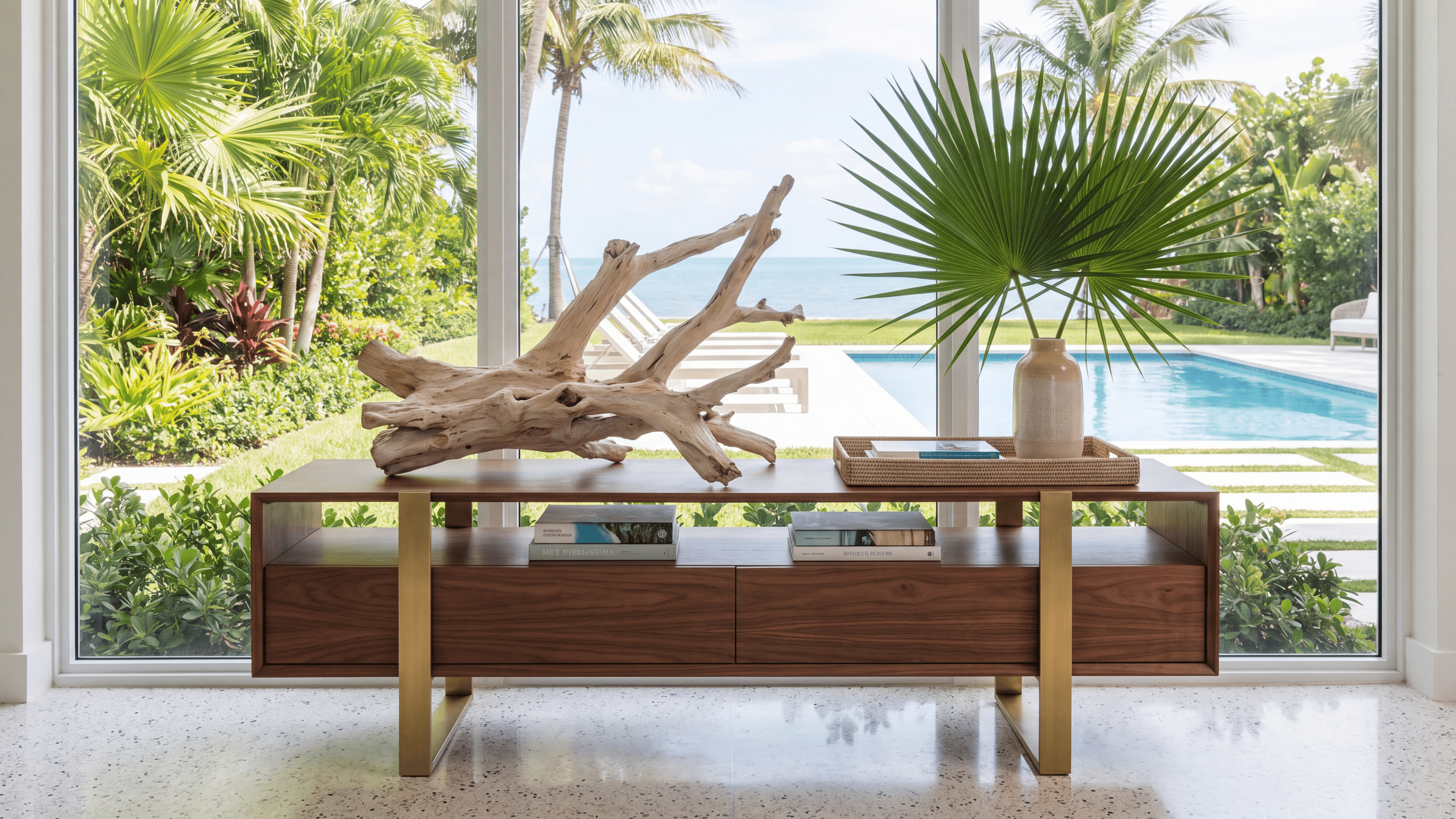
Perhaps the first interior designer was simply the first person who decided a branch belonged inside.
The Beautifully Unnecessary
There is something distinctly human about bringing home what we do not need.
Food is necessary. Water is necessary. Firewood is necessary.
But the flower?
The unusual shell?
The branch chosen because its form is slightly unexpected?
These choices reveal something more complex than utility.
At some point, survival created room for discernment. We began to ask not only Is this useful? but Is this beautiful? and Does it belong here?
That shift—from necessity to consideration—may be one of the defining moments in the history of design.
Beauty begins where function is no longer the only argument.
And what we call luxury may begin just beyond that point: when necessity is met, but attention continues.
A roof is necessary. The shadow of a tree moving across it is not.
A chair is necessary. Its precise relationship to a window, a sculpture, and a view is not.
Yet those are often the details that stay with us.
We rarely leave functional environments alone. We compose them.

The Room Is Never Finished When the Architecture Is
Architecture gives us structure: walls, openings, planes, thresholds, volume, proportion.
Then we begin to work within it.
We introduce linen and leather, stone and bronze, paintings, books, inherited objects, commissioned pieces, and carefully placed light.
And we introduce nature.
Especially nature.
A tree behaves differently in a room than anything else we place there.
Architecture is an act of control: lines are drawn, dimensions fixed, materials resolved, surfaces refined.
A tree does not follow those rules.
Its branches divide without a grid. Its leaves repeat with variation. Its trunk bends where a column would not. Its mass is uneven. Its negative space is irregular.
It introduces unpredictability into geometry.
And the geometry becomes more compelling because of it.
A palm beside a monumental wall alters scale. An olive tree against limestone clarifies the weight of the stone. Grasses beneath strict architectural lines introduce movement even when still.
Botanical form does not simply occupy space. It changes how space is read.

A Long Conversation
This relationship is not new.
At Pompeii, houses were organized around courtyards and gardens, and where real landscape ended, painted landscape continued. Walls became frames for imagined nature—plants, birds, fountains, distant views.
It was not enough to have a garden. The feeling of landscape was extended beyond its physical limits.
Someone studied leaves. Someone chose color. Someone decided where illusion should begin.
Across cultures, the same instinct appears in different forms.
Persian gardens shaped nature into ordered visions. Japanese architecture framed trees as living compositions. Mediterranean courtyards placed citrus and vines at the center of domestic life. European orangeries turned cultivation into architecture itself.
Botanical forms moved into stone, fabric, metal, and paint—preserved long after the plants themselves changed or disappeared.
Even when nature could not remain, its image was retained.
Attention, Not Excess
Luxury is often described in terms of rarity, price, or exclusivity. These are outcomes, not origins.
Before luxury had a language, there was simply the decision to give more attention than necessity required.
A stone was polished further. An edge was refined. A shell was chosen over another. A tree was placed with care.
Luxury begins where usefulness ends but attention continues.
Not excess—attention.
And in the most refined environments today, it is not quantity that defines quality, but precision of choice.
What is included. What is excluded. How light falls. How materials relate. How space is read over time.

The Paradox of Control
Modern architecture has achieved extraordinary control.
Temperature, light, sound, privacy, and material precision can all be engineered. Surfaces align to millimeters. Glass disappears. Systems respond instantly.
And yet, into these controlled environments, we often place something uncontrolled: a tree.
This contradiction is revealing.
The more precise a space becomes, the more valuable irregularity feels.
A branch interrupts symmetry. A canopy softens geometry. A plant introduces scale that cannot be fully measured.
Botanical form is both object and atmosphere. It occupies space while changing how that space is perceived.
Nature on Its Own Terms
But nature is not passive.
A living plant requires light, water, humidity, air, and time. It resists environments that ignore those conditions.
This creates a tension in design: the most compelling placement is not always the most viable for life.
Some spaces cannot support living plants at all—yet still call for their presence.
Historically, the answer has been compromise: seasonal replacement, relocation, or omission.
But there is another approach.
Nature, Interpreted
Humans have always translated nature without requiring it to remain alive.
We paint it, carve it, cast it, press it, and preserve it. We recreate it in materials that outlast it.
The question is not whether it is living, but whether it is understood.
A convincing interpretation depends on observation: how a species branches, where density forms, how light moves through it, how age changes its structure, how asymmetry creates believability.
These are not decorative decisions. They are studies in form.
A Landscape in Dialogue with Architecture
At Jardin du Monde, botanical work is not treated as placement, but as composition in dialogue with architecture.
Scale, structure, density, negative space, vessel, sightline, and material context all matter. A composition for a residence is not the same as one for a yacht or aircraft. A lobby asks different questions than a private room.
Context defines the answer.
The goal is not imitation, but belonging.
A successful work does not announce itself. It feels as though it has always been there—anticipated by the architecture rather than added to it.

Still Bringing the Landscape Home
I often think of the first person who carried something natural into shelter without practical reason.
A branch. A flower. A handful of grasses.
Others may have passed it by. This person did not.
That moment—simple, unrecorded—is where design begins.
Not in possession, but in attention.
Our environments have changed dramatically since then. We build in the sky, into cliffs, across oceans, and inside aircraft. Yet the gesture remains the same.
We continue to bring the landscape with us.
Sometimes alive. Sometimes represented. Sometimes reinterpreted in lasting form.
Thousands of years later, the impulse is unchanged.
Civilization may not be the story of leaving nature behind.
It may be the story of learning how to bring it with us, more deliberately each time.


