

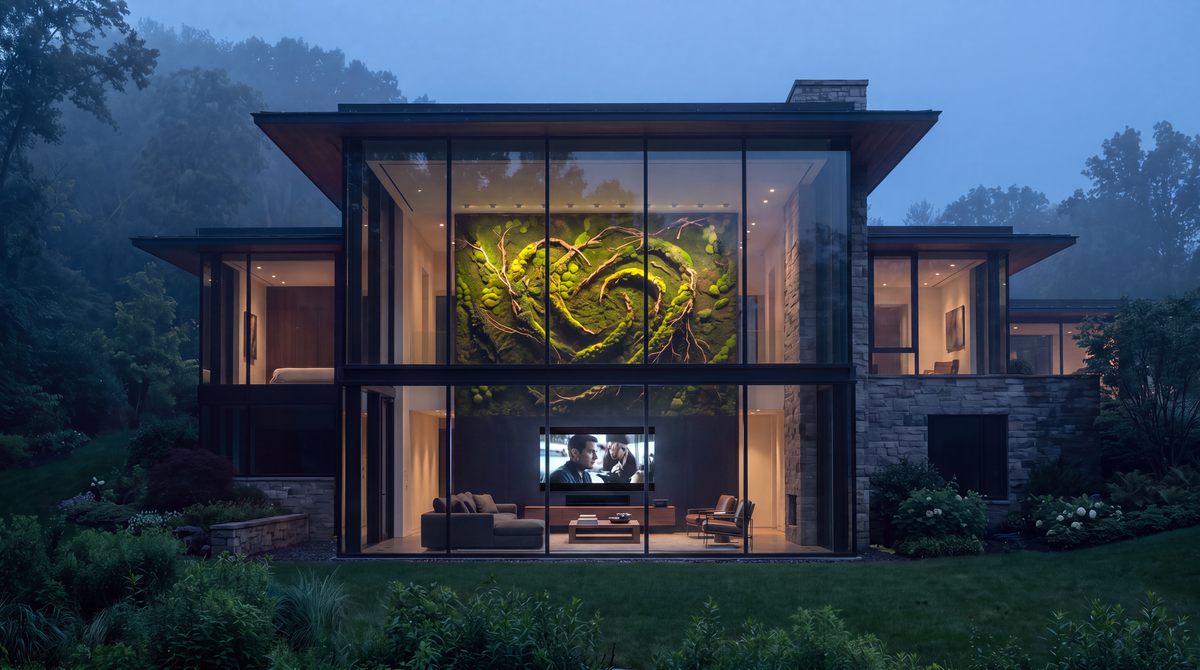
A residence is designed for the life being lived now. Its lasting value depends on whether it can continue to feel considered, relevant, and complete when another life begins there.
A home is composed in the present and judged again in the future.
Architects and designers do not often discuss terminal value across a table covered in stone samples and fabric swatches. The phrase belongs more naturally to investment models: the value expected to remain at the end of a defined holding period. In formal real-estate analysis, it is the exit value—the market’s future assessment of an asset after time, use, maintenance, and change have all made their mark.
Yet every exceptional residence contains a more intimate version of the same question. When the first owners have left, when the rooms are photographed again and another family crosses the threshold, what will remain persuasive?
The obvious answers are location, architecture, condition, proportion, light, and view. These are the durable fundamentals. But homes are rarely experienced as inventories of attributes. They are encountered whole and almost instantaneously. Before a prospective buyer studies the millwork or asks about the mechanical systems, the house has already communicated something: calm or confusion, generosity or indifference, permanence or fashion.
Botanical art enters here, not as a substitute for architectural value, but as one of the elements capable of making that value legible.
The Eye Appraises First
From the winter garden to the internal courtyard, domestic architecture has long invited nature inside. Plants soften boundaries, register scale, and give still rooms a sense of life. But the way greenery is used matters. A botanical element chosen simply to occupy an empty corner is decoration. A composition developed in conversation with the architecture can become part of how the room is understood.
Consider a double-height stair hall. Its volume may be impressive on paper yet feel strangely unmoored in person. A pair of sculptural traveler palms, calibrated to the rise of the staircase and the long sightline from the entry, can make the height intelligible. In a restrained limestone room, the open silhouette of an olive tree may provide the irregularity the architecture needs. Neither adds square footage. Both can clarify what the square footage is doing.
This distinction becomes especially meaningful when a house returns to market. The National Association of Realtors’ 2025 research found that 83 percent of buyers’ agents believed staging helped clients imagine a property as their future home. Twenty-nine percent of agents reported that staged properties received offers between 1 and 10 percent higher in value. Those figures describe staging broadly, not botanical art specifically, and they should not be mistaken for proof of a botanical premium. They do, however, reveal something important: presentation can influence whether a buyer understands the life a property is capable of holding.
The first valuation is emotional. The formal one follows.
 Coastal Stairway- Vandergild Residence | Naples, FL
Permanence Is Not the Same as Stasis
Fresh flowers are beautiful partly because they disappear. Living plants possess a different appeal: They grow, respond, and occasionally refuse to cooperate. Both have a place in a home. Neither, however, can be expected to preserve a designer’s original composition without continuing care.
Maintenance-free botanical art proposes another relationship with time. A carefully made canopy retains its intended density. A branch continues to bend toward the same architectural line. A composition conceived to balance a room does not gradually outgrow it, thin unevenly, or arrive at a viewing looking depleted.
For a residence expected to hold its visual integrity across seasons, absences, and eventually a sale, that consistency has practical value. The room remains ready to be photographed. An entry continues to make the gesture for which it was designed. A second residence does not depend upon the owner arriving days in advance to restore the landscape indoors.
But permanence alone is not enough. Anything can remain; far fewer things remain relevant.
The botanical work most likely to endure is rarely the loudest. It is grounded in species, proportion, setting, and restraint. It does not chase the color of a particular season or imitate a passing floral fashion. Instead, it responds to the architecture’s deeper language: the rhythm of an arcade, the vertical pull of a stair, the quiet geometry of a stone wall, or the way morning light travels through a room.
Longevity is not achieved by freezing a moment. It is achieved by understanding what the moment belongs to.
 Tropical Bursts - Lainey Residence | Saint Petersburg, FL
When an Object Begins to Belong
There is also a meaningful difference between portable decoration and site-specific work. A vase placed on a table may move with its owner. A botanical composition designed around a niche, integrated planter, paneled wall, or exact architectural sightline has a more complicated relationship to the house. It may remain a separate artwork, transfer with the residence by agreement, or become so visually associated with the setting that removing it changes how the architecture is perceived.
This is where botanical art begins to approach the territory occupied by commissioned furniture, lighting, or decorative arts. Its value is not located in the material alone. It resides in the quality of the making, the intelligence of the placement, the integrity of its provenance, and the precision with which it belongs.
A generic object can be replaced by another generic object. A successful commission is harder to exchange because it has solved a specific problem beautifully.
At Jardin du Monde, that is why a commission begins with the room rather than the flower. What is visible from the entrance? Where does the architecture need movement? Which forms already dominate? Will the work be seen primarily in daylight, at night, or through glass? Should it hold attention or quietly complete the composition? Botanical research and artisan construction come later, but belonging is established first.
The approach is aesthetic, yet it is also analytical. The right botanical silhouette can direct the eye toward a view rather than compete with it. It can soften an acoustically hard interior without introducing visual clutter. It can create a gracious pause between public and private rooms. And because the work is conceived for its environment, it is less likely to feel like an accessory awaiting the next redesign.
What Can—and Cannot—Be Valued
No responsible designer should promise that a botanical installation will add a predetermined amount to a home’s appraised value. Appraisals depend upon markets, comparable sales, property condition, and many other variables. There is no universal line item assigning a premium to a sculpted olive canopy. Nor should there be.
The more credible argument is subtler.
Botanical art can support the perceived coherence of a residence. It can help significant rooms photograph as complete rather than merely furnished. It can distinguish a property in memory after a buyer has walked through several impressive houses in a single afternoon. And when it is made to endure, it can preserve an intentional part of the interior without recurring replacement, water, falling leaves, or the visible decline that can undermine an otherwise immaculate space.
These effects do not replace the fundamentals of value. They frame them.
This framing is particularly important at the highest end of the residential market, where buyers are not choosing only among square footage and bedroom counts. They are comparing points of view. The more accomplished the architecture, the more conspicuous an unresolved room can become. Conversely, one beautifully judged gesture can make an entire space feel inevitable.
That feeling is difficult to enter into a spreadsheet. It is not, however, economically irrelevant. Desire has always participated in value, especially when the assets being considered are already exceptional.
 Earth's Origin - Private Residence | Tampa, FL
The House After Us
Terminal value asks us to imagine an ending. Design, at its best, asks us to imagine continuity.
The two ideas are not opposites. A home retains value when it can accommodate another chapter without losing the conviction of the first. Its stone will patinate. Its fabrics will change. Art will be rearranged, rooms will be repurposed, and another family will establish its own rituals. The goal is not to preserve everything untouched. It is to leave behind enough clarity that the house can continue to speak.
Botanical art can become part of that continuity when it is approached with the seriousness of architecture and the sensitivity of a living gesture. It can hold nature’s irregularity within a carefully considered interior. It can remain composed without appearing inert. Most importantly, it can help a house retain the quality buyers recognize before they can name it: the sense that every element belongs.
Perhaps that is the terminal value worth designing for—not merely what a home may be worth when it changes hands, but what it still knows how to make someone feel.
To explore a botanical commission conceived in conversation with your architecture, we welcome a private consultation with one of our Creative Directors at www.jardindumonde.com


