

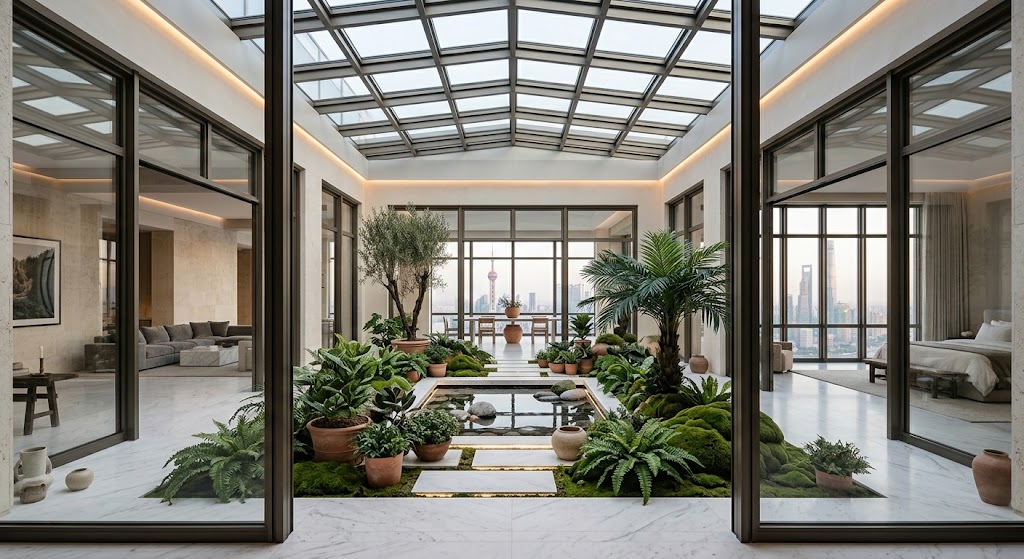
Every memorable room begins with an idea. Sometimes that idea arrives through stone, fabric, art, or architecture.
A designer may remember olive branches moving beside an old stone house. Another may recall tropical leaves outside a quiet hotel window. There could be ferns beside a shaded path after rain. Or a single cherry blossom branch against a pale wall in Kyoto.
These images stay with us. Years later, they return inside a room.
A tree appears beside a staircase. Greenery spills above a dining table. Foliage fills an architectural recess.
This is the deeper beauty of decorating with plants.
And today, fake plants allow that botanical inspiration to take many forms.
They can preserve a particular silhouette, mood, or composition long after the original idea was imagined.
Key Takeaways
- Fake plants can express landscape, memory, and atmosphere rather than simply imitate living greenery.
- Botanical interiors often begin with travel, art, architecture, or remembered natural settings.
- Different foliage shapes create distinct moods, from restrained to dramatic.
- Greenery changes how stone, timber, metal, and glass are experienced.
- Permanent plants can preserve a carefully composed botanical moment over time.
The First Inspiration Is Often a Landscape
Plants carry a strong sense of place. An olive tree suggests a different atmosphere from a tropical palm. A fern creates another feeling entirely.
Designers often respond to these associations before thinking about decoration.
A Memory of the Mediterranean
Picture pale stone warmed by afternoon sun.
Olive branches cast small shadows across a courtyard wall.
The palette feels effortless:
- Silvery green leaves
- Cream limestone
- Weathered timber
- Soft terracotta
- Sun-faded linen
The plants do not dominate the setting. They belong to it. That quiet relationship can inspire an interior without copying a Mediterranean garden.
One sculptural tree may be enough. A few loose branches in a stone vessel may carry the same memory.
A More Tropical Mood
Tropical inspiration feels entirely different. The foliage is broader. Shadows are deeper. Green feels almost architectural because of its scale. Large leaves beside concrete or dark timber can create a sense of shelter.
The room begins to recall a shaded veranda or coastal retreat. Yet the effect does not require an indoor jungle. Often, a few strong botanical shapes say more than abundance.
Plants Bring Something Architecture Cannot Control
Architecture loves straight lines.
Walls meet floors precisely. Joinery follows measured proportions. Stone edges align with glass.
Plants introduce another language. Their forms bend. Leaves overlap. Branches reach into empty space.
Nothing feels completely symmetrical. That irregularity is part of their charm.
A Little Disorder Can Complete the Room
Highly controlled interiors can sometimes feel distant. Everything may be beautifully resolved, yet slightly untouchable.
Botanical forms change that mood. They introduce softness without disturbing the architecture.
A curved branch interrupts a straight wall. A cluster of leaves softens a marble console.
Trailing greenery breaks the hard line of a ceiling. The room remains sophisticated. It simply becomes more human.
Why Fake Plants Can Feel Like Sculpture

Green is only part of the experience. Form often matters more.
Designers read foliage almost like furniture. A leaf has proportion, rhythm, silhouette, and movement.
Different botanical forms create different moods.
- Fine leaves can feel delicate and graphic.
- Broad foliage can feel generous and dramatic.
- Trailing forms introduce softness.
- Sculptural branches feel restrained and artistic.
- Dense greenery creates intimacy and visual depth.
This is where fake plants become especially interesting. They allow a designer to preserve a specific shape. The composition can remain exactly as intended.
The focus shifts away from imitation. It becomes about line, scale, and atmosphere.
Sometimes the Inspiration Comes From Art
Not every botanical interior begins outdoors.
It may begin with a painting. A dark still life might inspire deep green against blackened wood. A modernist artwork may suggest one leaf against a pale wall.
Photography can be equally influential. Think of sunlight passing through palm leaves.
The image may stay in a designer's mind long after the photograph disappears.
Greenery Becomes Composition
At that point, plants are no longer accessories. They become part of a visual arrangement.
The designer begins thinking about:
- Where density should sit
- Where the eye needs emptiness
- How foliage frames a view
- Which forms catch the light
- Where shadows should fall
Negative space becomes essential. Botanical forms need room around them.
That breathing space gives the greenery presence.
Without it, even beautiful foliage can become visual noise.
Green Changes the Materials Around It

One reason plants remain so compelling indoors is their relationship with other materials.
Greenery rarely works alone. Its character changes beside stone, timber, plaster, or metal. Imagine dark leaves beside pale travertine. The stone suddenly feels warmer.
Place the same leaves against brushed bronze. The metal appears richer.
Against walnut, the greenery feels softer and deeper.
Nature Makes Hard Materials More Expressive
This contrast is especially beautiful in restrained interiors. The architecture provides discipline.
The plants introduce irregularity. Neither needs to compete.
Instead, each makes the other easier to notice.
This is where botanical design becomes less about filling empty space. It becomes a way of revealing the materials already present.
When a Botanical Moment Is Worth Preserving
Living plants bring change into a room. That change can be beautiful.
Leaves grow. Branches move toward light. The shape evolves over time.
Sometimes, however, a designer wants one particular composition to remain. Perhaps a trailing form needs to fall at an exact point.
Maybe a wall needs to maintain the same visual density. A sculptural arrangement might depend on a precise silhouette.
This is where fake plants offer another creative possibility.
Holding the Original Gesture
Permanent plants allow a composition to stay visually consistent. The idea is almost painterly.
One large leaf may anchor the arrangement. Fine greenery may soften the edges. A darker layer may create depth behind everything else.
Once the balance feels right, it remains.
The room still changes.
Daylight travels across the walls. Furniture develops patina. Objects move. The botanical gesture stays intact.
For certain interiors, that stability becomes part of the story.
From a Single Branch to an Immersive Wall
Botanical design does not need to be large.
Sometimes one expressive form carries an entire room.
A single tree beside a staircase can become unforgettable. One branch may create enough movement against an otherwise quiet wall.
Other spaces invite something more immersive. Greenery may fill a double-height surface.
A botanical screen may create privacy around an outdoor lounge. Foliage may appear overhead, almost like a canopy.
The scale changes. The underlying inspiration does not.
It still begins with a feeling.
Fake Plants Do Not Need to Pretend
The most sophisticated botanical interiors stop trying to reproduce a garden literally.
A wall of foliage may feel closer to sculpture. A branch can behave like a drawn line.
Layered leaves may resemble a textile. Shadows can become as important as the plants themselves.
This is where fake plants move beyond imitation. Their purpose is not simply to convince someone they are real. Their value comes from what they contribute to the room.
- Texture.
- Shape.
- Softness.
- Memory.
- Atmosphere.
Nature provides the original language. The designer edits it.
What remains is not a replica of a landscape. It is the memory of one.
The Room Remembers the Garden
We may never consciously recognize why certain interiors feel calming. Perhaps we recognize a familiar rhythm.
Branches against sky. Leaves beside stone. Filtered light across a forest floor.
The proportions may be different. The materials certainly are.
Yet the memory remains.
That may be the deeper reason plants continue appearing across centuries of interior design. They remind us of places architecture cannot fully reproduce.
Living or permanent, restrained or abundant, greenery carries that memory indoors. The most compelling spaces do more than decorate with plants. They allow the room to remember a landscape. Check our website Jardin Du Monde for more articles like this.
Frequently Asked Questions
Q: Can fake plants look sophisticated in luxury interiors?
A: Yes. Their impact depends on form, scale, quality, placement, and their relationship with surrounding materials.
Q: Why do designers use fake plants instead of living plants?
A: Sometimes the design requires a stable shape, consistent density, or placement unsuitable for living greenery.
Q: Do fake plants work in minimalist interiors?
A: Yes. Their irregular forms can soften clean architectural lines without adding excessive decoration.
Q: What makes fake plants feel more natural?
A: Varied shapes, restrained color, realistic texture, and thoughtful spacing create a more convincing botanical composition.
Q: Can fake plants become part of architectural design?
A: Yes. Large installations can function as botanical walls, screens, sculptural features, or visual anchors.
Q: Are fake plants only useful where real plants cannot grow?
A: No. They can also be chosen for visual consistency, composition, scale, and a specific design concept.


