

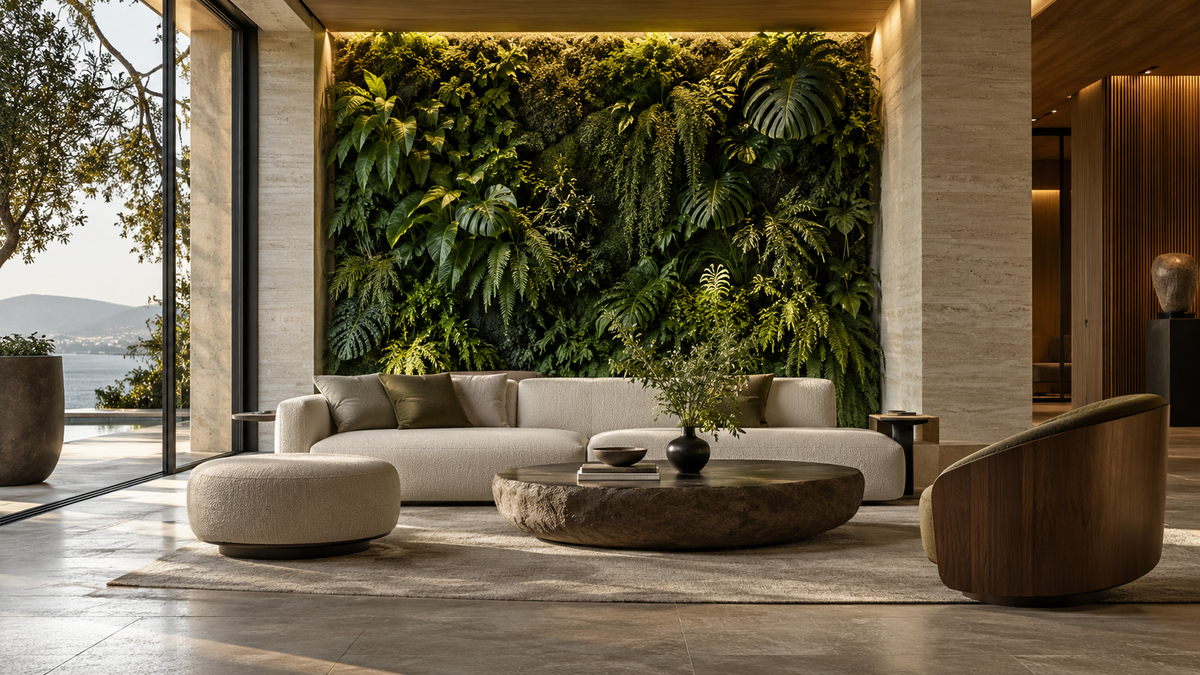
Architecture has always held a fascinating tension with nature.
We build with materials chosen for permanence. Travertine, concrete, walnut, dark steel, and glass all carry a sense of control.
Then greenery enters the room.
Its softness unsettles those hard surfaces. Its irregularity changes the rhythm. Suddenly, the architecture feels less absolute.
For decades, living plant walls seemed to offer the perfect union. They brought foliage directly into the architectural plane.
Yet living greenery follows its own rules.
Leaves stretch toward light. Plants respond to temperature. Growth alters the composition. Time reshapes what the designer originally imagined.
That unpredictability is part of nature's charm. It is also what separates nature from architecture when it outgrows its respective boundaries.
Faux plant wall decor introduces another possibility.
Here, botany becomes form rather than horticulture. Greenery becomes texture, relief, and shadow.
The wall no longer needs to behave like a garden.
It can behave like architecture.
Key Takeaways
- Faux plant wall decor can read as architectural art rather than decorative greenery.
- Permanent foliage allows botanical form to remain visually consistent over time.
- The strongest installations feel sculptural, restrained, and deeply connected to surrounding materials.
- Light transforms botanical walls by revealing depth, silhouette, and shadow.
- Luxury lies in composition, not abundance.
From Living Wall to Architectural Surface
The fascination with vertical greenery changed how designers thought about plants indoors.
Botanist Patrick Blanc helped popularize living walls across large architectural surfaces.
The idea was radical in its simplicity.
Plants no longer sat beside architecture.
They became part of it.
Greenery climbed walls, softened concrete, and introduced movement across previously static planes.
The effect was theatrical, yet deeply natural.
As interiors became more restrained, another question emerged.
What happens when botanical beauty is separated from biological change?
That question opened a different creative direction.
Permanent botanical surfaces began to feel less like substitutes. They started to resemble another architectural material.
Foliage as Sculpture
The most compelling installations borrow their language from relief sculpture.
Leaves project from the wall. Fine stems cast delicate shadows. Dense botanical layers form darker recesses.
The surface changes as the viewer moves through the room.
From a distance, it reads as one continuous field.
Up close, the composition becomes intricate.
Fern-like shapes create fine texture. Broad leaves introduce quieter planes. Moss-like forms soften the spaces between them.
Nothing needs to imitate a wild garden exactly.
The beauty comes from abstraction.
Nature provides the vocabulary. Architecture provides the discipline.
The Luxury of Contrast

Botanical walls become most interesting beside materials that seem completely opposed to them.
Imagine dense greenery against pale limestone.
The stone feels calmer.
Place it beside blackened steel, and the metal appears sharper.
Set it within walnut, and warmth becomes more pronounced.
This contrast gives faux plant wall decor much of its visual power.
It is not the greenery alone that creates the effect.
It is the conversation between materials.
Softness Against Structure
Large architectural planes carry visual gravity.
Concrete feels heavy. Stone feels permanent. Metal feels precise.
Botanical texture interrupts that certainty.
Tiny edges replace broad surfaces. Layered shadows soften clean geometry.
The eye moves between the two.
That movement creates tension without noise.
In refined interiors, this can feel far more luxurious than adding ornament.
The architecture remains disciplined.
The greenery simply gives it another emotional register.
Where Light Meets Foliage
A botanical surface changes dramatically under light.
Morning light may reveal individual leaves while evening light can turn the same wall into a deep field of shadow.
This is where permanent greenery becomes especially sculptural.
Its silhouette remains stable.
The shadows may change with the room, but the form itself stays composed.
A Wall That Changes Without Moving
Directional light catches edges first.
Then it falls into the spaces between leaves.
Some forms disappear into darkness. Others seem to float above the wall.
The effect can feel surprisingly cinematic.
A warm beam creates softness.
Side lighting produces stronger relief.
Low light turns the greenery almost abstract.
The wall remains still, yet its character changes throughout the day.
That is perhaps its most elegant quality.
It offers visual movement without physical transformation.
The Art of Visual Continuity

Modern interiors often blur the boundaries between rooms.
Glass walls disappear. Terraces extend living spaces outward. Materials continue across thresholds.
Botanical surfaces can participate in that same visual continuity.
A deep green wall may begin in an interior lounge.
Its line can continue toward a covered terrace beyond the glass.
The greenery becomes a visual thread.
It connects spaces without demanding that each space share identical growing conditions.
The result feels calm and deliberate.
Nature is referenced, but never forced.
Botanical Walls in Luxury Interiors
The most memorable botanical interiors rarely feel like indoor jungles.
They feel edited.
Restraint gives the foliage presence.
A narrower palette allows texture to become more noticeable.
A precise frame can make irregular leaves feel almost jewel-like.
The greenery becomes one element within a larger composition.
Monochrome in Green
Deep green against warm stone has a particular elegance.
The color is familiar, but the surface feels layered.
Dark leaves recede.
Lighter tones move forward.
Matte foliage absorbs light while glossier leaves catch it briefly.
The wall becomes quietly complex.
It does not need flowers or bright accents to hold attention.
Its richness comes from tonal depth.
Framed Like Art
There is something compelling about placing organic forms inside strict geometry.
A botanical panel may sit within walnut.
Another may be bordered by stone or a slim metal channel.
The frame creates tension.
Inside, the foliage remains irregular.
Outside, the architecture stays exact.
That meeting point feels distinctly modern.
It turns greenery into something closer to artwork.
When Greenery Follows the Architecture
Some interiors allow the botanical surface to escape the wall entirely.
It may rise behind a staircase.
It may wrap around a column.
In larger spaces, it can move onto a soffit or ceiling plane.
The effect is more immersive.
Yet it still feels architectural when the gesture remains controlled.
The greenery follows the structure.
It does not overwhelm it.
What Makes a Faux Plant Wall Decor Feel Luxurious?

Luxury is often mistaken for abundance.
In reality, the most sophisticated spaces usually depend on editing.
The same is true of faux plant wall decor.
Its elegance comes from rhythm, depth, proportion, and restraint.
Uniformity can feel artificial.
Variation feels more natural.
Yet too much variation creates visual noise.
The strongest compositions live somewhere between those extremes.
There is repetition, but never obvious repetition.
There is richness, but also calm.
Every layer contributes to the whole.
That is what makes the wall feel considered rather than applied.
Beyond Imitation
The most interesting faux botanical walls no longer need to convince anyone they are alive.
That idea feels increasingly beside the point.
Their value lies elsewhere.
They capture some of nature's most expressive qualities.
Softness. Irregularity. Shadow. Movement. Layering.
Then architecture gives those qualities permanence.
This is what makes the modern botanical wall so compelling.
It sits between two worlds.
One is organic and instinctive.
The other is controlled and exact.
Faux plant wall decor becomes the point where those worlds meet.
Not a copy of a garden.
Not simply a decorative surface.
Something quieter, more deliberate, and far more architectural.
Check our website at jardindumonde.com today!
Frequently Asked Questions
Q: Is faux plant wall decor considered luxury interior design?
A: It can be. Luxury comes from composition, material quality, restraint, and its relationship with the surrounding architecture.
Q: Why does faux plant wall decor work well in modern interiors?
A: Its organic texture softens precise architecture while preserving the clean visual language of modern spaces.
Q: Can faux plant walls feel artistic rather than decorative?
A: Yes. Layered foliage can resemble relief sculpture, especially when light, shadow, and framing shape the composition.
Q: Does faux greenery work with stone and timber interiors?
A: Beautifully. Greenery intensifies the character of natural materials by creating contrast in texture, color, and visual weight.
Q: Why are monochromatic botanical walls popular in luxury spaces?
A: Tonal greens feel calm and sophisticated. They let texture and shadow carry the visual drama.
Q: Can faux plant wall decor connect indoor and outdoor spaces?
A: Yes. A continuous botanical language can visually link adjoining spaces without depending on identical environmental conditions.


