

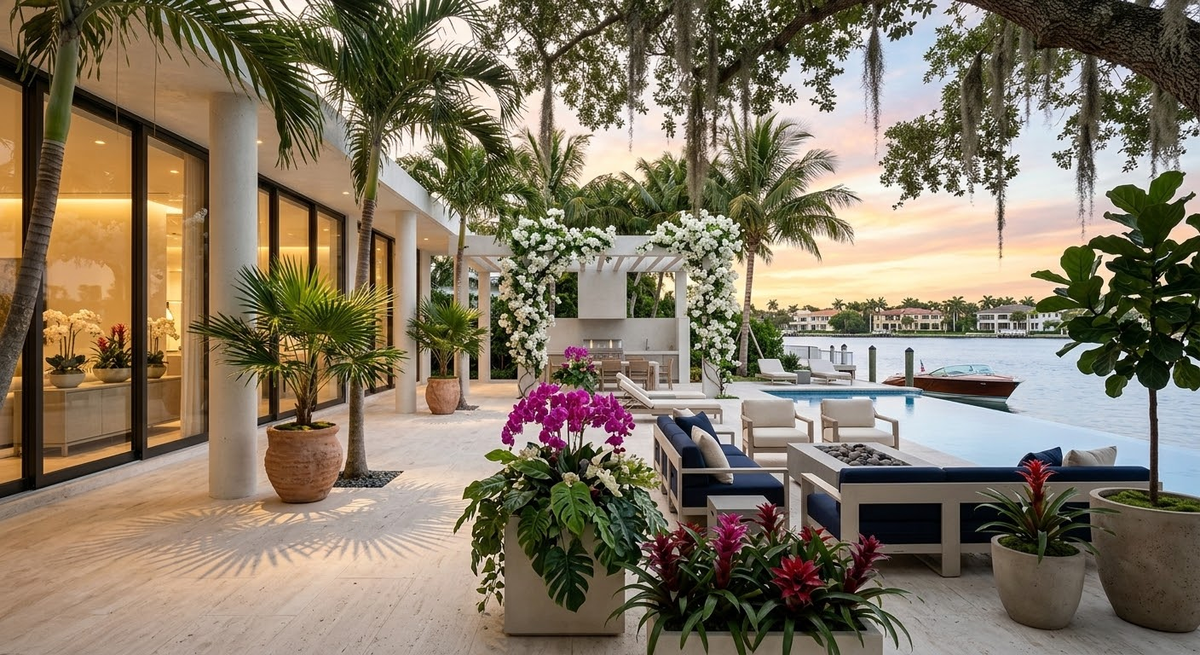
Before structure became minimalist, landscape was expressive.
It spilled across verandas, climbed travertine facades, and softened the rigid boundaries of stone and steel. Color was not an afterthought. It was part of an ongoing dialogue between architecture and the changing seasons.
Then came the modern requirement for control.
Lines became sharper. Glass expanded. Surfaces aligned with almost mathematical precision.
And yet, living organic elements introduced a quiet contradiction. Wind strips petals away. Sun alters color. Coastal air, shaded courtyards, and exposed terraces make certain blooms difficult to sustain.
Architecture asks for continuity.
Nature is defined by change.
That tension is precisely where faux outdoor flowers become compelling—not simply as substitutes for living flowers, but as design elements capable of holding botanical form within an architectural composition.
Key Takeaways
- Faux outdoor blooms keep a steady look, even when seasons shift or the weather changes.
- The appeal is in the mix of contrasts. Soft plant shapes sit next to hard stone. Natural unevenness breaks up clean lines. Color stays in calmer ranges.
- In current building design, flowers can be used as part of the plan. They do not have to be treated like something pasted on after the fact.
- With time, a faux bloom becomes more than a short moment. It stays as part of the structure.
- The best faux botanicals do not try to copy nature exactly. They read it in their own way.
The Tension Between Permanence and Change
Modern architecture is built around endurance.
Stone is selected for the way it will weather. Metal is specified for finish and patina. Glass is positioned to control reflection, transparency, and light.
Living flowers follow another logic.
Architecture Seeks Continuity
A terrace composed of pale limestone, dark steel, and carefully proportioned furniture may depend on a restrained area of botanical color. When that color appears only briefly, the balance of the composition changes with it.
Faux outdoor flowers introduce permanence into something traditionally ephemeral.
The bloom becomes less of a seasonal event and more of an architectural constant.
A flower is present not simply because the season allows it, but because the composition calls for it.
Nature Introduces Time
Living gardens carry their own rhythm. They emerge, mature, fade, and retreat.
That impermanence is beautiful, yet it does not always align with architecture designed around controlled sightlines and consistent material relationships.
The contrast between those two systems—one permanent, one temporal—is what gives faux botanicals their conceptual relevance.
Organic Form Against Modern Geometry

Modern architecture is often defined by geometry: vertical planes, horizontal rooflines, repeated grids, uninterrupted glass, and precisely cut stone.
Botanical form speaks a different visual language.
Softness Creates Contrast
Leaves bend. Stems arc. Petals overlap. Silhouettes resist perfect symmetry.
Against rectilinear architecture, these irregular forms introduce softness without disturbing the discipline of the space.
The effect is similar to other material contrasts:
- polished stone beside textured timber
- reflective glass against matte plaster
- dark metal beside pale natural surfaces
- precise geometry interrupted by an organic silhouette
Each element becomes more legible through the presence of its opposite.
Botanicals work in much the same way. Their curves make straight lines feel sharper. Their softness gives mass greater presence.
In this context, faux flowers become a biomorphic counterpoint to architectural geometry.
Color as an Architectural Material
Modern exterior palettes tend to be restrained.
Limestone, concrete, bronze, timber, glass, and darkened metal create environments where color is often carefully rationed.
Within that restraint, flowers carry unusual visual weight.
Color Establishes Emphasis
A red bloom against pale travertine becomes a focal point. White petals against charcoal stone alter the perceived depth of the surface behind them. Deep green foliage can strengthen the warmth of bronze or timber.
Color begins to behave less like ornament and more like material.
It can:
- create visual emphasis
- establish repetition or rhythm
- interrupt a large neutral plane
- connect separate areas of a composition
- soften otherwise austere materials
Living flowers make those relationships temporary.
Faux outdoor flowers allow the color relationship itself to remain part of the architecture.
Nature, Interpreted Rather Than Recreated
Faux botanicals are often judged by one question:
Do they look real?
But architecture has never simply reproduced nature.
Stone is cut into planes nature would not create. Timber is milled into exact dimensions. Water is contained within geometric pools. Trees are aligned into formal axes.
Landscape design has always involved interpretation.
Botanical Form as Abstraction
Faux botanicals belong to this same tradition.
They separate the flower from its biological requirements while preserving its defining visual qualities: silhouette, color, rhythm, scale, and softness.
The aim does not need to be the perfect imitation of a garden.
Within highly composed architecture, the more interesting objective is to translate botanical form into a language that belongs to the building around it.
Controlled Nature and the Modern Landscape

Modern architecture often seeks connection to nature without surrendering control.
Glass walls dissolve the boundary between interior and exterior, yet frame the landscape precisely. Courtyards bring sky and vegetation into a home, but within measured walls. Infinity pools appear to merge with the horizon while depending on exact engineering.
Even spaces that feel effortless are often carefully composed.
Nature, Edited
Faux outdoor flowers fit naturally within this idea of controlled nature.
They retain the recognizable presence of a bloom while reducing its unpredictability.
Nature is present, but edited.
For a loose, evolving garden, that degree of permanence may feel unnecessary. Within architecture defined by precision, however, it can become part of the visual concept itself.
Softness, Mass, and Perception
Large architectural surfaces carry visual weight.
A monolithic stone wall feels heavy. Concrete appears grounded. Dark metal can feel dense even when physically thin.
Flowers alter how those materials are perceived.
Small Forms, Large Influence
A botanical silhouette beside stone can make the stone feel more monumental. A delicate floral form against glass can make transparency appear even lighter.
The contrast sharpens perception:
- hardness becomes clearer beside softness
- large planes feel more expansive beside fine detail
- stillness feels more deliberate beside organic irregularity
Botanical elements may occupy relatively little space, yet their influence on the overall composition can be significant.
Their role is perceptual rather than structural.
The Permanent Bloom
There is something inherently contradictory about a flower that does not fade.
That contradiction is also what makes the idea architecturally interesting.
A permanent bloom exists somewhere between nature and object. It borrows its form from the living world but behaves more like sculpture.
Botanical in Form, Architectural in Behavior
It does not depend on a flowering season. It does not retreat as temperatures change.
Instead, it becomes part of the material composition of the space.
Seen this way, faux outdoor flowers are botanical in appearance but architectural in behavior.
Their permanence allows them to operate closer to stone, metal, furniture, or art than to traditional seasonal planting.
The bloom becomes an object of continuity.
A More Permanent Expression of Landscape
Living gardens possess something artificial botanicals cannot reproduce.
They move through time. They flower unexpectedly. They retreat. They change with weather and season.
That impermanence is part of what makes them extraordinary.
But architecture sometimes asks for another relationship with nature.
It asks for a line to remain balanced. A particular color to hold its position. An organic form to soften stone without disappearing with the season.
In those spaces, permanence becomes part of the design language.
At Jardin du Monde, we see faux outdoor flowers not simply as representations of nature, but as a way of translating botanical form into architecture.
The objective is not to force nature to behave like a building.
It is to understand what architecture has always done with the natural world: observe it, interpret it, and give its forms a new permanence.
Frequently Asked Questions
Q: Can fake outdoor flowers sit next to real plants?
A: Yes, they can. Real plants bring new growth, motion, smell, and shifts with the seasons. Fake flowers hold one steady look, like a fixed splash of color, especially where it is hard to grow. Put together, they help a yard feel both lively and stable.
Q: What makes outdoor faux flowers different from ones meant for inside?
A: Outdoor faux plants are built for weather. They often use UV tolerant materials and color fading blockers that can handle sun, rain, heat swings, and wind. Faux plants made for indoors may fade, droop, or change shape when they are left outside.
Q: What does outdoor light do to faux plants?
A: Lighting can change how faux flowers look once the sun goes down. Side lighting can bring out the rim of petals and leaves. Soft light at night can calm the glare and make the piece fit the yard. In the dark, shadows matter as much as color.
Q: Do permanent faux botanicals make a place feel less seasonal?
A: Not always. A fixed plant can work as a base point, while other parts of the yard still change. Seasonal feel can come from live plants, weather, daylight angles, fabrics, and nearby greenery. You can have both a steady element and seasonal variation.


