

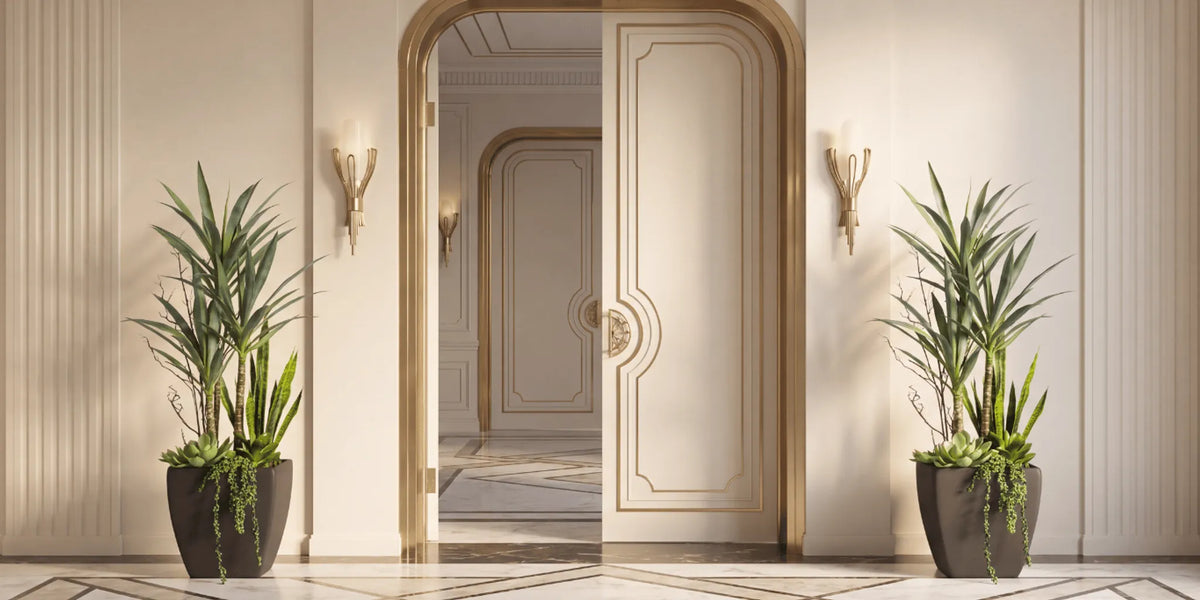
A room can feel carefully furnished and still seem unfinished. Often, the missing element is not another accessory but a considered botanical composition: one that relates to the architecture, gives the eye a place to rest and brings a sense of life to the room. Choosing a planter is part of that design decision. The vessel determines how the composition meets the floor, relates to nearby furniture and contributes to the atmosphere. This guide to how to choose a planter for artificial plants begins with the whole room, then moves through scale, form, finish, stability and placement.
Begin with the feeling the room needs
Before considering a vessel, name what feels unresolved. Is the room visually spare, even though it contains everything needed? Does a long wall lack a point of focus? Is a reading corner pleasant but slightly detached from the rest of the space? These observations lead to better choices than beginning with a color or a product photograph.
A planter and its botanical form work together as one composition. In a formal living room, a tall, sculptural silhouette may give a quiet corner presence. In a softly layered bedroom, a more restrained form can contribute gentle movement without competing with textiles and art. In an entry, the vessel may establish the tone as soon as someone enters. The right choice is not simply a container that holds stems. It is the base, visual weight and finishing note of a complete arrangement.
Write down three things the composition should do. For example: soften a strong architectural line, add height beside a low console, and bring a warm natural note to a restrained palette. Then record what it should not do: obstruct a view, interrupt a walking route, or demand attention from a cherished artwork. These limits give the selection direction.
Read the architecture before choosing a planter
Look at the room from its main entrance and from the places where it is most often used. Notice ceiling height, window proportions, doorways, built-ins, wall divisions and the lines of the furniture. A botanical piece should feel as though it belongs in this setting, rather than appearing to have been placed there without regard for its surroundings.
Architecture offers cues for the vessel. A room with strong rectilinear detailing may welcome a rounded or gently tapered planter that introduces a softer counterpoint. A space with curved furniture or sweeping lines may benefit from a more structured vessel. These are design possibilities, not rigid rules. The important question is whether the contrast feels intentional and whether the piece supports the room's existing rhythm.
Pay attention to the floor as well as the walls. A planter placed over a patterned rug adds another shape and boundary. On a quiet stone or wood floor, the same vessel may read as a sculptural object. Check whether the base will sit fully on the available surface and whether the composition will overlap a rug edge, a floor register, a cabinet door or another feature. A few inches can change how deliberate the placement feels.
Choose scale with a few practical checks
Scale is a relationship, not a single measurement. Consider the height and width of the full composition, the vessel's footprint, nearby furniture and the negative space around the piece. A planter that looks generous in isolation may seem undersized beneath a high ceiling. A large vessel can feel imposing beside a delicate side table. Think about the plant and planter as one silhouette, then judge that silhouette against the room.
Measure the available height
Measure from the floor to the ceiling, but also note the height of nearby furniture, windowsills, artwork and architectural features. If the piece will sit beside a sofa, compare its total height with the sofa back and the surrounding wall. If it will stand near a console, consider how its upper foliage relates to the console surface and any objects above it.
Leave visual breathing room. A composition pressed tightly between a ceiling and a tabletop can feel crowded, even if it technically fits. Where possible, mark the approximate total height with removable tape or a temporary vertical measure. Step back to the room's normal viewing points. This simple exercise can reveal whether the intended height feels calm, prominent or overwhelming.
Check width and footprint
Measure the usable floor area, not just the empty patch visible in a photograph. Include the sweep of a nearby door, drawers that open, chairs that move, and the space people need to pass. The vessel's base may be narrower or wider than its widest point; note both. A broad upper profile can visually occupy more room than its floor footprint suggests.
Also consider the width of the botanical silhouette. The vessel should neither disappear beneath a very broad composition nor dominate a delicate one. A useful first check is to view a scaled outline or taped rectangle from across the room. It will not reproduce the exact impression of foliage, but it can test whether the overall mass belongs in the intended location.
Think in terms of visual weight
Visual weight comes from several elements at once: height, density, color, branch direction, vessel shape and finish. A narrow planter can still feel substantial when paired with a tall, full composition. A broad vessel in a quiet finish may feel calm rather than heavy. When a room already holds large pieces of furniture, an arrangement with a clear silhouette and a considered base can hold its own without adding visual clutter.
Do not choose by height alone. A slender piece may suit a narrow passage while a more expansive silhouette can anchor a generous corner. Look at the whole outline from a distance and ask whether it balances the mass of the furniture around it. If you are unsure, compare a few possible proportions through a sketch or a simple room photograph marked with approximate dimensions.
Match the planter form to the botanical silhouette
The vessel should give the botanical form a convincing visual foundation. A tree-like composition often calls for a base with enough presence to support its upward movement. A low, spreading arrangement may feel more settled in a wider, lower vessel. A delicate branching form can become visually top-heavy if the planter appears too slight beneath it. Consider the width, height and direction of the branches together with the shape of the vessel.
Look at the transition between foliage and vessel. A full composition that narrows at the base may benefit from a planter that creates a clear, grounded finish. A design with a distinctive trunk or stem may call for a simpler vessel that allows that feature to remain visible. If decorative surface media is part of the presentation, consider how it will read at the opening of the planter and whether its color supports the overall palette.
Consider silhouette at eye level and from above. A piece viewed while seated may present differently from one seen standing in an entry. The rim, opening and upper contour of the planter can be more visible from a mezzanine, stair landing or balcony. Walk through the room and observe the likely angles before settling on a form.
Give the vessel finish the same attention as the foliage
Finish is one of the strongest ways to connect a botanical composition to its room. A restrained surface can let branching structure take precedence. A more expressive texture may echo stone, woven elements, hand-finished furnishings or another tactile detail already present. The aim is not to match every object. It is to establish a coherent relationship.
Build from the room's existing palette
Identify the dominant colors in the room, then note the accents that should remain visible. A planter can quietly repeat a tone from flooring, a console, a lamp or a piece of art. It can also introduce a subtle contrast that makes the composition legible against the surrounding surfaces. Both approaches can work; choose according to the mood you want.
Take account of undertones. A pale finish can read warm beside honey-toned wood and cool beside blue-gray stone. A dark vessel may disappear into a shadowed corner, or it may create a clear anchor against a light floor. Examine the proposed finish in the room's actual light and alongside nearby materials, rather than relying only on how it appears on a screen.
Use texture with intention
Texture can create depth, especially in a room built around calm colors. A finely textured planter might add quiet interest beside smooth upholstery. A highly patterned finish may compete with a patterned rug or expressive artwork. Count the visual statements already present in the area. If several strong patterns meet in one view, a quieter vessel can help restore order.
Gloss, sheen and matte appearance also affect perception. A reflective surface draws attention to highlights and nearby colors; a more subdued surface tends to keep the eye on shape and texture. This is a visual consideration rather than a claim about a particular finish's durability. Select the appearance that best supports the room and confirm care guidance for the exact piece when needed.
Consider the vessel as a lasting design element
A planter is often more visually stable than the accents around it. Ask whether its finish will make sense if a cushion, artwork or small accessory changes. A finish drawn from a fundamental room material can provide continuity. A distinctive color may be appropriate when it is a deliberate focal point, but it should have a clear relationship to the composition and architecture.
When comparing options, look beyond a small isolated image. Imagine the vessel at its actual scale beside the furnishings and within the light of the room. Note its shape, opening, base and surface, and consider how each of those qualities will read from the entry, seating area and adjoining spaces.
Consider stability and the conditions of the location
Stability is both a practical and visual concern. A composition should appear grounded, and the vessel should be appropriate for its intended position. Think about the relationship between the width of the base, the height and spread of the botanical form, and the movement of the surrounding space. A high-traffic entry, a narrow walkway and a quiet corner each raise different placement questions.
Before ordering or arranging a piece, confirm the product's supplied dimensions and configuration. Ask whether the pictured vessel is part of the selected configuration or shown as a styling example. If the product page offers choices, review the selected size and finish carefully. For a room-specific proposal, share measurements and photographs so the design conversation can account for the actual setting.
Do not assume every vessel or botanical composition is suitable for every exposure or use. If the location is outdoors or exposed to strong sun, check the guidance for the specific item. Outdoor suitability varies by product; no general description should be taken as a promise that every piece is suited to exterior conditions. Similarly, do not assume a piece is intended to be moved, secured, or installed in a particular way unless that guidance is provided for the selected item.
For homes with children or pets, consider the placement carefully and ask the seller about the configuration rather than assuming details about weight, anchoring or construction. Keep a clear path, avoid locations where the piece could be repeatedly bumped, and follow any care or placement instructions supplied with the specific composition. These simple checks help the chosen object feel at ease in daily life.
Let the room determine the placement
A planter can be beautiful and still feel misplaced. Placement should account for sightlines, circulation, natural light, furniture use and the room's focal points. Stand at the doorway and ask what the composition will frame. Sit where you usually relax and see whether it supports the view or interrupts it. Then walk the route people use through the space.
Entries and transitional spaces
An entry composition can create a welcoming sense of arrival and connect the home's threshold to its interior character. Keep the route to doors, closets and stairs open. A planter may be more effective slightly to one side of the main line of movement than directly in the path. Check the view from both inside and outside the entry, and make sure the piece does not compete with a nearby mirror, artwork or console.
Living rooms and conversation areas
In a living room, a botanical piece can soften a corner or complete a view behind a sofa. Preserve the relationships between seats: people should be able to see and speak to one another without an arrangement cutting across the conversation. If the room already has a strong focal point, such as a fireplace or an expansive window, use the composition to support that focal point rather than create an unnecessary rival.
Bedrooms and quieter rooms
Bedrooms often benefit from a composition that contributes calm rather than spectacle. Consider the view from the bed, the swing of doors and the space around bedside furniture. A piece can provide a gentle visual counterweight to a large wardrobe or soften an unadorned wall, while remaining distinct from the functional surfaces used every day.
Dining rooms, offices and shared spaces
In a dining room, keep chair movement and access to the table in mind. In a home office, notice the background seen from the desk and any camera position used for calls, while keeping the work area clear. In a shared reception or hospitality setting, consider how the composition reads from different approaches and whether it preserves an orderly route through the room. These are placement considerations, not claims about a particular installation service.
Use light as a design consideration
Light changes how both foliage and vessel are perceived. Daylight may reveal undertones, texture and shadow that are less apparent in a product image. A corner that seems bright in the morning can become subdued later in the day. Observe the location at the times when the room is most often used, and note whether direct sun falls on the intended position.
Electric lighting within the room is another part of the composition. A floor lamp or architectural light can cast shadows that emphasize branching structure, while an overhead fixture may illuminate the vessel more strongly than the foliage. Think about the evening view as well as daylight. A beautiful object should make sense in the atmosphere the room actually has, not only under ideal conditions.
Do not use light assumptions to infer product performance. If a position receives prolonged direct sun or is exposed to outdoor conditions, verify the guidance for the specific piece. The design question is where the composition looks most considered; product suitability must be confirmed separately for that item.
Make the vessel part of a complete room composition
The most resolved botanical moments relate several elements: architecture, atmosphere, scale, vessel, species or form, and light. Consider each one in turn. Architecture gives the composition its setting. Atmosphere determines whether the room should feel serene, formal, intimate or expressive. Scale establishes its presence. The vessel grounds the silhouette. The botanical form gives it character. Light completes the impression.
Look for connections rather than literal repetition. A branching silhouette might echo the movement of a nearby sculptural lamp without copying it. The vessel may carry a tone found in the flooring, while its shape creates a gentle contrast with the furniture. A restrained palette can still feel richly considered when proportions and textures are varied with care.
Leave room for negative space. Not every empty corner needs a composition, and not every available surface should be filled. A deliberate pause can make the selected piece feel more important. If a room has many accessories, edit the immediate area before adding another element. The result should feel composed, not crowded.
Choose between a configured piece and a room-specific proposal
There are two sensible routes to a botanical composition. A configured piece from the catalog may suit a room when its published dimensions, available vessel and overall appearance are already a good fit. Explore the Jardin Du Monde botanical art collection when you are considering a configured piece. A design consultation may be useful when the room has unusual proportions, several connected sightlines, a particular palette or a placement that is difficult to assess from a product image alone.
For a catalog selection, review the product details and configuration before proceeding. Confirm the selected dimensions, vessel choice, shipping information and any product-specific guidance. Do not assume that an image shows every available option or that a pictured arrangement includes styling elements not named in its description.
For a consultation, prepare a concise design brief. Include clear photographs taken from the main approaches, approximate room dimensions, ceiling height, measurements of the intended floor area, and the positions of doors, windows and nearby furniture. Add a few words about what feels unresolved and what you hope the composition will contribute. If you have a preferred palette or reference image, share it as context rather than as a demand for an exact copy.
Jardin Du Monde describes design discussions as available virtually or in person, followed by a room-specific botanical proposal. Delivery and on-site styling are upon request, rather than included automatically with every purchase. Confirm the details relevant to your project directly with the team. No particular visit area, fee, timeline or installation scope should be assumed without confirmation.
Test the composition before committing
A short room study can resolve doubts that are difficult to settle from a screen. Start with a photograph taken from the doorway or the seat where you spend the most time. Mark the intended planter footprint on the floor with painter's tape, then place a temporary vertical marker at the approximate height of the full botanical form. Use a box or another object to suggest the vessel's width if the footprint alone is hard to read. This is not a substitute for confirming product dimensions; it is a way to see how much visual and physical space the proposed composition may occupy.
Review the marked space from three distances. Stand close enough to see whether the planter crowds a chair, door or cabinet. Step back to assess its relationship to the room's main furniture. Then look from the adjoining space to see whether the silhouette interrupts a view or creates a graceful transition. If the room has an open plan, repeat the check from each zone. A placement that feels balanced from the sofa may appear too dominant from the dining table, and that difference can guide a more precise position.
Use a simple comparison note for each candidate. Record overall height, approximate width, vessel footprint, finish, intended location and the view it supports. Add one sentence describing the intended effect, such as “soften the hard edge beside the bookcase” or “give the entry a calmer point of arrival.” If two options appear equally appealing, return to this sentence. The one that answers the room's need more clearly is often the more coherent choice.
It can also help to compare the planter against samples or objects already in the room. Hold a finish reference near the floor and nearby furniture, then view it during daylight and after the room's evening lights are on. Avoid judging a tone from memory: a warm neutral may look different beside cool stone than beside natural timber. If exact product samples are unavailable, treat any screen image as an initial guide, not a guarantee of how the finish will appear in your home.
Finally, check the composition in ordinary use. Open the door fully, pull out a dining chair, walk through the passage and sit in the usual places. Notice whether the piece remains part of the room rather than becoming an obstacle or a distraction. Keep the measurements and photographs together so that any product question or design discussion can be specific. A few careful observations at this stage can prevent a selection based on a single attractive angle.
A measured selection process
- Describe the need. Identify what the room lacks and what the composition should contribute. Keep the answer about the room's feeling and function, not just a plant name.
- Record the setting. Measure the available height and footprint, then note furniture, circulation, doors, windows, floor materials and sightlines.
- Set the intended presence. Decide whether the piece should anchor a corner, soften a line, frame a view or offer a quieter accent.
- Consider the full silhouette. Compare the height and width of the botanical form with the vessel and nearby furnishings. Allow visual breathing room.
- Select a finish with context. Relate color and texture to the room's materials, taking undertones and natural light into account.
- Check the practical details. Review product-specific dimensions, configuration, placement and exposure guidance. Ask about details that are not stated.
- Revisit the room view. Look from the entrance, seated positions and adjoining spaces. Check the walking route and everyday use of nearby furniture.
- Choose the right path. Select a configured piece when the published option fits; request a design conversation when the room needs a more tailored proposal.
Common selection missteps to avoid
Choosing from a close-up alone
A close crop can show texture or finish, but it cannot establish how the piece will relate to a ceiling, sofa or room opening. Look for full-composition dimensions and consider the vessel in the context of the actual space. When those details are not available, ask before making assumptions.
Letting the planter compete with the composition
A distinctive vessel can be compelling, but too many competing shapes and textures in one area can make the arrangement feel unsettled. Decide which element should lead. If the botanical silhouette is the focus, give it a vessel that supports it. If the planter is intended as a sculptural accent, keep the surrounding objects more restrained.
Ignoring circulation
It is easy to focus on an empty corner and overlook the way the room is used. Check chair movement, doors, drawers, walkways and access to windows. A composition that repeatedly interrupts daily movement is unlikely to feel at home, no matter how well its colors are chosen.
Matching a finish without checking undertones
A color that appears to match online may shift against the room's materials. Compare the proposed finish with wood, stone, textiles and wall color under the light found in the intended position. A related tone often creates a more nuanced result than an exact match.
Assuming one specification applies to every item
Configurations and suitability can vary by product. Read the details for the exact composition under consideration, especially when location or exposure matters. Ask a direct question if the published information does not address your circumstances.
Questions to settle before you select
- What is the room missing: height, softness, a focal point, or a transition between zones?
- Where will the composition be seen from most often?
- What are the full available height and floor dimensions?
- Which furniture, architectural features and walking routes must remain clear?
- Should the planter blend quietly with existing materials or provide a considered contrast?
- What finish and shape will feel at ease beside the room's current palette?
- Does the exact product information address the intended location and conditions?
- Would a configured catalog piece answer the need, or would a room-specific proposal be more useful?
For further room-by-room design considerations, visit the Jardin Du Monde journal.
What should a planter contribute to the room?
A well-chosen planter should make the botanical composition feel grounded and the room feel more complete. Its scale should relate to the architecture and furniture; its finish should sit naturally within the palette; and its placement should respect the light, views and movement of the space. There is no universal vessel that belongs in every room. The best decision comes from noticing what the room needs, measuring what it can hold and considering the planter as part of the whole composition.
Take time to assess the room before choosing. When the vessel, botanical form and architecture work in concert, the composition can bring a quiet sense of intention to the space.


