

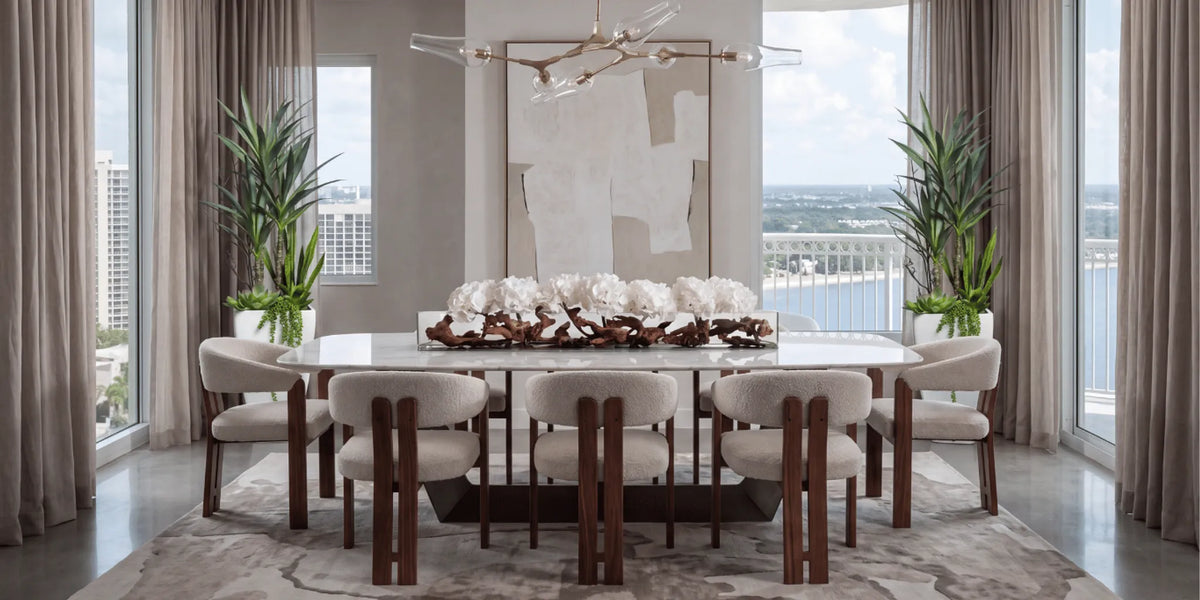
Choosing artificial plants versus real plants for interiors is not simply a question of which looks more natural. It is a decision about the room’s light, the rhythm of care you want to maintain, the presence greenery should have, and how the composition relates to the architecture. A considered choice can make a room feel settled rather than merely furnished.
Book a private design consultation
Begin with the feeling the room needs
Living plants bring change into a room. New leaves, growth and seasonal shifts can make a composition feel active and connected to its environment. That quality can suit a sunny kitchen, a generous conservatory or a room where tending plants is part of the pleasure of living there.
Permanent botanical art offers a more composed presence. Its silhouette and placement can be chosen for a particular corner, console or architectural line, without depending on continued growth. It can be useful when a room needs a lasting visual anchor, or when regular plant care does not fit the household’s routines.
Neither choice is automatically more beautiful. The right question is what the room asks for: a living element that changes over time, or a considered botanical form that holds its place in the design. Notice whether the room feels cold because it lacks softness, whether a corner feels empty because it lacks height, or whether a busy surface needs a quieter gesture. Naming the design need first helps keep the decision focused.
Be specific about the feeling you want. “More green” is a starting impression, not yet a design brief. You may want to soften a sharp transition between a stone wall and a seating area, give an expansive room a human scale, or make an entry feel composed on arrival. Each intention points toward a different outline, height and placement. A spreading form may soften a broad, bare wall; a more vertical silhouette may relate to a window or a tall cabinet. Decide what the botanical presence should do before settling on its form.
It is also useful to name what should remain unchanged. Perhaps the room already has a strong artwork, a view, or an architectural feature that deserves attention. In that case, the greenery should support rather than displace the focal point. A subtle arrangement can establish continuity between furnishings without asking to become the centre of the room. This is an important distinction: a successful composition does not have to be the largest or most conspicuous object to make the interior feel complete.
Read the light before choosing
Light is one of the first practical considerations for living plants. A bright window may support a broader selection, while a dim hallway or deep interior corner can narrow the options. The needs of individual species differ, so assess the actual conditions where the plant will sit rather than relying on the room’s general impression of brightness.
Missouri Extension explains that indoor lighting can be designed to support houseplants in many settings, but supplemental light requires a plan. See its guidance on lighting indoor houseplants for an overview.
A permanent composition does not depend on growing conditions in the same way. Yet light still matters aesthetically. Daylight, lamps and shadows shape how foliage, color and vessel read in the room. A placement that looks balanced at noon may feel different in the evening, so observe the space at the hours it is most often used. Consider whether glare from a window washes out delicate detail, or whether a shaded wall needs a stronger silhouette to remain present after dusk.
Take a few observations before you choose: note the direction of the window, the hours of direct sun, and the way the room is lit after sunset. For a living plant, this helps you match the species to its setting. For botanical art, it helps you decide on color, contrast and placement. The same corner may suit both in different ways, but the criteria are not identical.
A simple light record can make this assessment more useful. At morning, midday and late afternoon, note whether sunlight reaches the intended location directly, whether it is filtered through curtains, or whether the area remains in shade. Then check the room after dark. The goal is not to turn the choice into a technical exercise; it is to avoid mistaking a bright window for a bright room. A plant several feet from the glass may experience different conditions from one placed on the sill. If you are considering a living species, use its care guidance to interpret what you observe.
For a permanent arrangement, look at how the light reveals detail. Side lighting can show texture and create a more sculptural outline. Strong backlighting may make a dark silhouette appear crisp but can also obscure subtle tonal variation. Warm evening lamps can shift the perceived color of foliage and a vessel. If possible, assess the proposed placement from the room’s principal seat, not only from close range. The composition should read well where you actually spend time.
When a room has uneven light, think in zones rather than making one decision for the whole interior. A living plant may suit the bright window, while permanent botanical art may be more appropriate in an interior passage or a sheltered corner. This need not create a visual mismatch. Relate the choices through a recurring tone, a similar vessel finish, or a shared sense of scale. A considered palette can make varied botanical forms feel like part of one home.
Compare the care each choice asks of you
Living plants need care suited to their species and setting. That may include watering, checking soil, pruning, repotting or responding to changing light. The exact routine varies; there is no single schedule that applies to every plant. Consider honestly whether the care itself would be welcome, or whether it would become another task competing for attention.
Think through a normal week rather than an ideal one. Who will notice when the soil is dry? Will someone be home to tend the plant during travel? Is there a convenient place to water it without carrying a heavy pot across the room? These practical questions do not diminish the pleasure of living greenery; they make its care more realistic.
Permanent botanical art does not need watering or growth management. It still benefits from thoughtful placement and occasional attention to dust or handling, according to its materials and care instructions. Do not assume that every piece can be cleaned in the same way; follow product-specific guidance.
For a home where travel is frequent or routines are already full, the reduced need for plant care may be an important design consideration. It is not a promise that a piece requires no attention at all. Equally, for someone who enjoys nurturing a living plant, its ongoing care can be part of the satisfaction. The useful distinction is not care versus no care, but which kind of attention fits the way the room is used.
Make a care map before bringing a living plant into a carefully finished room. Identify the nearest practical water source, the route from that source to the pot, and a safe place to set the plant while tending it. Think about the floor and nearby furnishings, too: routine care should not require awkwardly moving objects or risking spills on delicate materials. If the plant needs a different position at some point, consider whether there is a suitable alternate location in the home.
Then include the household, not only the room, in the decision. A plant may be a pleasure when one person enjoys noticing its changes and tending it as part of a weekly rhythm. It may be less well suited when care would fall to someone who did not choose it. Ask who will take responsibility during holidays, busy seasons or changes in routine. A realistic plan is kinder to both the plant and the people who live with it.
For permanent botanical art, learn the care guidance for the specific materials and finish rather than assuming that every composition can be treated alike. Ask how to remove dust safely, whether the vessel has any placement considerations, and how to handle the piece if a room is rearranged. These are modest questions, but they prevent avoidable damage and help the composition retain a considered appearance. Keep any care instructions with other information about the room’s furnishings.
Care also has a visual dimension. A living plant’s appearance may change as it grows or responds to its surroundings, while a permanent composition is selected for a stable outline. Decide whether you enjoy tending a plant partly because its appearance develops, or whether you would rather reserve your attention for other parts of the home. Neither preference needs defending. A room should support the daily life of its occupants rather than impose an ideal routine.
Think about longevity as a design experience
Living plants grow and respond to their environment. That evolution can be a virtue: the composition develops, and the owner can prune, repot or reposition it as it changes. It also means that the original scale and shape may not remain fixed. A plant that fits a small table today may need a different place later.
Permanent botanical art is selected for a stable visual role. Its intended form does not grow into a new silhouette, which can help maintain a carefully planned relationship to furniture, ceiling height and circulation. The term “permanent” describes the design intention, not a guarantee of a particular lifespan. Materials, care and environmental conditions all matter.
Consider the emotional quality of that difference. Some rooms benefit from a changing element that makes the interior feel alive in a literal, seasonal sense. Other rooms are already layered with books, art, textiles and objects; a consistent botanical form can provide a note of calm rather than another changing variable. Neither preference is more sophisticated. It is a question of the atmosphere you want to experience daily.
When choosing either option, consider the room beyond the day of purchase. Will the plant’s future growth suit its location? If the composition is meant to stay visually consistent, does its scale feel right for the architecture and surrounding furnishings? Also think about future room changes: can a living plant be moved as it grows, and will a composed piece retain its relevance if furniture is rearranged?
Think in terms of the room’s likely life rather than an abstract promise of permanence. A home may gain a new sofa, lose a side table, or change from a formal sitting room to a family gathering space. A botanical form with a clear relationship to the architecture may adapt through repositioning, while a living plant may offer the pleasure of gradual change and a new shape. If a composition relies on a particular piece of furniture, ask whether it still makes sense if that furnishing moves.
There is also a difference between visual longevity and material longevity. A composed piece may be intended to maintain a particular appearance, but its condition depends on materials, handling, placement and care. Do not interpret the idea of eternal botanical art as a guarantee that a piece is indestructible or requires no attention. For living plants, likewise, do not assume a particular lifespan: their wellbeing depends on species and conditions. A sound decision acknowledges what is known and leaves room for the individual object and setting.
For a room with a strong, long-established design, a stable botanical outline may help maintain its balance. In a less settled room, the changing shape of a living plant can be an invitation to adjust the arrangement over time. You might begin with a plant in a flexible location while deciding how the room should evolve. Or you might use a composed form to establish a clear focal point before choosing other furnishings. In both cases, the question is whether the change belongs in the room’s story.
Think, too, about the emotional experience of repeated viewing. A living plant may draw attention through new growth or seasonal shifts. That can make a familiar room feel subtly renewed. A permanent composition may instead offer a reliable visual note that lets other details change around it. If your eye is already drawn to many moving elements, a composed silhouette can provide quiet. If the room feels static, the living quality of growth may be welcome.
Choose the kind of flexibility you value
Living plants offer biological variety and change. Their form can shift as they grow, and an owner may enjoy discovering how a species responds to its environment. That flexibility is organic, but it is not always predictable or easy to direct.
A designed botanical composition offers a different flexibility: choice of silhouette, scale, vessel and placement before it enters the room. A configured piece can provide a direct route when the need is clear. For a room-specific approach, a design discussion can consider the room and its décor before a proposal is developed. Delivery or on-site styling is available upon request, not included automatically with every purchase.
Jardin Du Monde’s collection of luxury botanical pieces can help you explore the range of forms. For a more architectural perspective on the relationship between plants and a room, see botanical art and interior design. A configured catalog piece and a room-specific consultation are distinct paths; the latter is useful when placement, scale or vessel choices need to be considered as part of a wider composition.
Flexibility is not only the ability to move an object. It is also the ability to specify what the room needs. A living plant gives you a form that may change as it grows, and you can respond through pruning, repotting or relocation where appropriate. A composed piece makes decisions about outline, scale and vessel more deliberate at the outset. One route foregrounds an ongoing relationship with growth; the other foregrounds a designed result. Consider which process you would enjoy.
If the need is clear and the placement is straightforward, a configured piece may be sufficient. You may already know that a room needs a vertical accent beside a window, or a floral gesture on a console. If the room has several competing constraints, a room-specific discussion may help organize them: the dimensions, light, existing décor, desired atmosphere and placement. The consultation process is distinct from choosing a catalog item. It is an opportunity to discuss the space and develop a proposal; delivery or styling can be requested but is not automatically included.
For a tailored decision, gather a few useful references before a design discussion: a photograph from the room’s main viewpoint, rough measurements, images of nearby materials and a note about how the room is used. These details help make the conversation concrete. You do not need to arrive with a fully formed answer. It is enough to describe what feels unresolved and what should remain central to the room.
Look at the complete composition
Greenery rarely feels resolved when chosen in isolation. Consider the ceiling height, nearby furniture, the vessel, the shape of the foliage and the available light together. A tall tree may need visual breathing room. A compact arrangement may be more appropriate on a narrow console. The vessel should belong to the room’s materials and proportions, rather than appearing like an afterthought.
Start with the architectural lines. A vertical form can echo a tall window or soften a column; a lower, broader arrangement can give weight to a long console. Keep circulation in view. A piece should not make a passage feel narrow or crowd a door swing. If the room already has a strong focal point, botanical art can support it rather than compete for attention.
For living plants, also account for the practical space around the pot and the conditions required by the species. For permanent botanical art, assess how its outline meets nearby art, windows and furniture. In either case, a carefully placed piece should contribute to the room’s atmosphere without interrupting movement or competing with a focal point that already works.
Color and texture matter as much as height. A dark, finely branched silhouette can recede against a shadowed wall; a lighter foliage tone may read more clearly. A polished vessel can introduce formality, while a quieter finish may let the botanical shape lead. Bring swatches or photographs of nearby materials into the decision, and view the proposed scale against the actual furniture rather than in isolation.
Read the composition from more than one position. From the doorway, does it welcome the eye or sit awkwardly across a route? From the principal seat, does the foliage frame a view, interrupt it or disappear against the background? At close range, are the leaves and vessel in scale with surrounding objects? A choice that works in a photograph from one angle may feel too dominant or too slight in daily use. The room’s ordinary viewpoints are the right test.
Give the vessel the same attention as the botanical form. Its height changes the perceived proportion of the arrangement; its width affects the visual footprint; its finish connects it to the room’s materials. A vessel that is too small can make a generous composition appear precarious, while an overly emphatic container may draw attention away from the form it supports. Consider the vessel in relation to the floor, furniture legs and nearby finishes. The whole arrangement should feel intentional from base to highest point.
Scale is most useful when considered as a relationship. Measure the available wall or corner, then compare that space with the adjacent furniture and ceiling. A tall composition placed next to a low console may make the console feel more substantial, but only if there is enough clear space around it. A broad shape beside a narrow walkway can make movement feel constrained. Marking a rough outline with removable tape gives the eye a reference before you commit.
Also consider visual weight. Dense foliage can feel substantial even when its actual dimensions are modest; an open silhouette may occupy more height while appearing lighter. This distinction matters in rooms with strong architectural detail. A heavy outline can balance a large cabinet or stone fireplace; a more open form may be better near delicate furnishings or a slim window frame. Evaluate the profile rather than relying on height alone.
Consider the room’s use and rhythm
A botanical choice belongs to a daily setting, not only to a photograph. In a living room, think about sightlines from the principal seat and whether the composition frames a view or blocks it. In an entry, consider what greets someone on arrival and how much floor space remains for movement. In a dining room, keep the arrangement in proportion to the table and ensure it does not obstruct conversation across it.
Bedrooms and quieter sitting rooms may call for a softer, more restrained outline. A study or executive office may need a form that brings warmth without distracting from work. These are not fixed rules. They are prompts to ask how the room is experienced, where the eye rests, and whether the botanical presence supports that experience.
Living greenery may suit a spot where care is easy to incorporate into an existing routine, such as near a frequently used window or sink. Permanent botanical art may be more practical for a location that is difficult to reach or where changing conditions make living growth harder to plan. Evaluate the exact placement rather than assuming that one answer applies to every room in the home.
Consider the rhythm of the room across the day. A living area may be active in the evening and quiet during the day; an entry is passed through in brief moments; a study is experienced for long stretches from one chair. A botanical composition should suit those patterns. In a frequently used passage, protect a clear route and avoid a placement that invites accidental contact. In a room used for extended periods, observe whether the outline remains calming from the main seat rather than becoming a distraction.
In a dining space, the tabletop is only one part of the decision. A floor composition can establish presence near a sideboard or window without taking up the table. If you are considering an arrangement on a table, relate its height to seated sightlines and the width of the surface. In a living room, use the existing seating plan as a guide: the botanical form might anchor an underused corner, soften the transition to a reading chair or balance the visual weight of a large cabinet.
An entry often benefits from a clear sequence: arrival, a place to pause, then movement into the home. A botanical form can mark that transition, but it should not interfere with doors, bags or the natural path through the space. In a bedroom, a calm outline may support a restful atmosphere, while an imposing focal form could feel too assertive. These are observations to test in the specific room, not universal rules about which plants belong where.
Make a considered choice
- Identify the room’s purpose. Note where people spend time and what the space currently lacks: softness, height, color or a sense of completion.
- Observe the conditions. Record the light at different times and consider the care routine that is realistic for the household.
- Set the intended scale. Relate the botanical form to the ceiling, furniture and circulation, not just to an empty corner.
- Decide whether change is welcome. Choose living growth if its evolving character appeals to you; choose a stable composition if a consistent silhouette better serves the design.
- Review the vessel and placement. See the whole arrangement in context before making a final selection.
Before committing, make a simple room note. Include a photograph taken from the main viewpoint, a rough measurement of the available width and height, the distance from nearby furniture, and the hours when the room receives direct light. This is useful whether you are visiting a nursery or considering a designed composition. It turns a vague impression into details that can guide a proportionate decision.
Then test the visual footprint. Mark the approximate base and height with removable tape or a temporary stand-in, and live with that outline for a day. Notice whether it interrupts a route, feels too slight from across the room, or draws the eye in the intended way. A quick test can reveal proportion problems before a purchase and helps clarify whether the room needs a tree-like vertical form, a spreading shape or a smaller accent.
Make a short decision brief with four headings: intention, conditions, care and composition. Under intention, write the feeling or function the room needs. Under conditions, note the light, available floor area and access around the placement. Under care, describe who will tend a living plant and what attention feels realistic. Under composition, record the approximate height, silhouette and vessel character you have in mind. This brief does not need to settle every detail; it helps separate essential needs from passing preferences.
Next, test the decision against the room as a whole. Take the photograph you made from the principal viewpoint and look at it alongside images of the room’s materials and furnishings. Ask whether the proposed botanical form introduces a needed contrast or repeats something already present. If the room has several strong textures, a quieter silhouette may be enough. If its palette and lines feel very restrained, a more sculptural shape could provide the focal note. The point is to make the greenery part of an existing design language rather than an isolated addition.
Before selecting a living species, check its specific growing needs and compare them with the conditions you recorded. Before selecting permanent botanical art, review the exact dimensions, materials and care guidance for the piece. If a product page provides multiple configurations, make sure you are considering the intended size and vessel, not a different option shown in the same collection. For a room-specific proposal, discuss the placement and design context directly rather than assuming the catalog configuration includes a tailored service.
Give yourself a final pause before purchasing. Revisit the proposed location at the time of day when the room is most often used. Check that the piece does not crowd a door, block a view or compete with an artwork that matters to you. If the room is still in transition, decide whether the botanical choice should establish a lasting anchor or remain flexible while other furnishings are selected. This last review often clarifies whether the decision is about the plant itself or about a larger composition that has not yet been resolved.
Common selection missteps to avoid
- Choosing by species alone. A plant’s name does not show whether its scale and silhouette suit the room.
- Ignoring the actual light. Check the placement rather than assuming every part of a room has the same conditions.
- Underestimating care. Be candid about whether ongoing attention is a pleasure or an obligation.
- Leaving the vessel until last. The container is part of the composition and affects its overall presence.
- Expecting a permanent form to behave like a living one. One changes with growth; the other is designed to keep a chosen appearance.
Another common misstep is choosing a piece only because it fills an empty corner. First decide what the corner needs to do in the room: create a transition, soften a hard edge, frame a window, or balance a substantial piece of furniture. If no clear role emerges, the space may benefit from a different intervention instead of greenery.
It is also easy to judge a composition against a close-up image rather than from the distance at which it will be seen. Step back. Consider how its outline relates to the whole wall and how the vessel meets the floor. The right selection should make sense both up close and from the room’s principal viewpoint.
Do not let an attractive vessel obscure a mismatch in scale. A beautiful container cannot compensate for an arrangement that blocks circulation or looks too slight beside the architecture. Likewise, a well-proportioned botanical form can feel unfinished when its vessel conflicts with nearby materials. Review both together, then review them again in the room rather than making each decision in isolation.
A further misstep is treating a room’s general brightness as proof that every location is suitable for a living plant. Light changes across the room and through the day. Assess the actual placement and the requirements of the species. In the other direction, do not assume a permanent composition will automatically look right in a dark corner; its tone and outline still need enough contrast to remain legible in the light available.
Finally, resist choosing solely from an idealized image of how the room might be used. Consider the ordinary version of daily life: the route people take, where they sit, when the room is lit and who will care for a living plant. A choice that serves those ordinary moments is more likely to feel at home than one selected only for a special occasion or a single photograph.
What should your interior ask of its greenery?
Choose living plants when you value growth, natural variation and the care that supports them. Choose permanent botanical art when a room calls for a composed form that does not rely on growing conditions, while remembering that materials and care still matter. The decision becomes clearer when you consider the light, scale, vessel and daily life of the room as one design question.
Discover permanent botanical art
When the choice reflects both the atmosphere you want and the way you live, greenery can become an intentional part of the room rather than a finishing gesture added at the end.


