

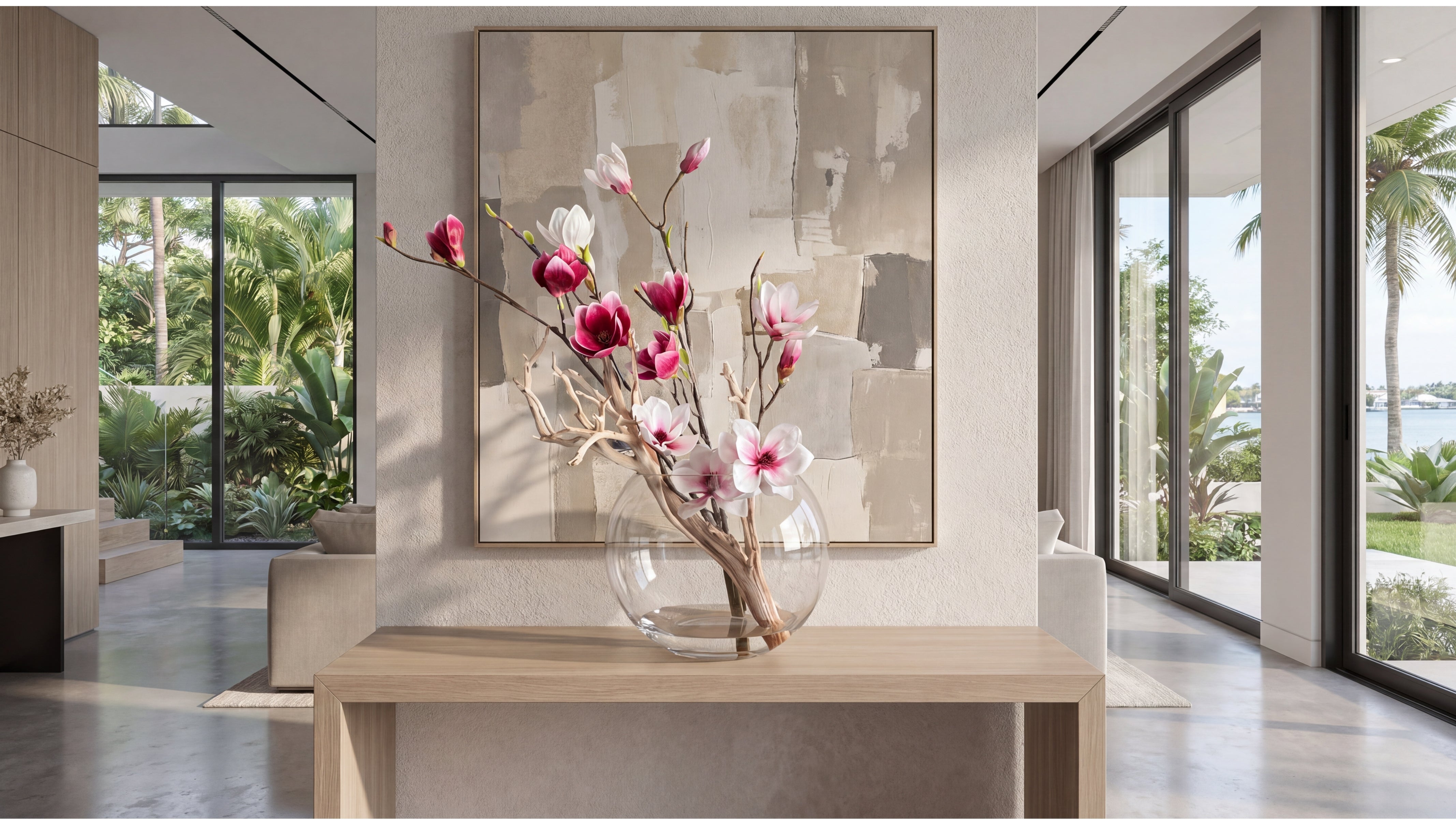
For decades, luxury has competed on an increasingly familiar equation.
Better materials. Better craftsmanship. Better heritage. Better storytelling.
The assumption has been simple: create a more beautiful object, and you create a more desirable brand.
It was true. Until it wasn't.
Today, some of the most memorable luxury experiences have surprisingly little to do with the object itself. They are remembered because of the way the environment made someone feel. Long after the purchase is forgotten, people remember the atmosphere, the stillness, the light, the scent, the sense that, for a moment, the world had been intentionally composed around them.
The next era of luxury is no longer competing through objects.
It is competing through environments.
The invisible architecture of luxury
Walk into two residences with identical square footage, identical furniture budgets, and identical architectural quality.
One immediately slows your breathing.
The other simply looks expensive.
The difference is rarely visible on a specification sheet.
It lives in something much more difficult to quantify: environmental identity.
Every environment quietly teaches us who we are while we occupy it.
Architecture influences movement.
Natural light influences mood.
Texture influences comfort.
Sound influences attention.
Botanical presence influences stress, memory, and emotional restoration.
Together, these elements create something larger than aesthetics. They create an internal narrative.
The environment becomes part of a person's identity.
That is what luxury is increasingly selling.
Not ownership.
Not decoration.
Identity reinforced through place.
Why the industry is measuring the wrong thing
Interior design has traditionally been evaluated by visual outcome.
Awards celebrate aesthetics.
Photography celebrates composition.
Social media celebrates moments.
But the human brain does not experience spaces as photographs.
It experiences them as continuous emotional interactions.
Most luxury environments are optimized for arrival.
Very few are optimized for living.
An extraordinary entrance means little if the environment becomes emotionally invisible after a week.
The true measure of luxury should not be how impressive a space appears on the day it is completed.
It should be how it continues to shape the emotional lives of the people who inhabit it years later.
That is a completely different design objective.
AI is quietly changing the role of physical luxury
Artificial intelligence is becoming exceptionally good at reducing friction.
It recommends products before we search.
It compares specifications instantly.
It plans travel.
Curates wardrobes.
Designs rooms.
Answers questions.
The transactional layers of luxury are becoming increasingly automated.
Ironically, this makes physical environments dramatically more valuable.
As digital experiences become faster, smarter, and more personalized, our expectations for the physical world evolve alongside them.
People no longer enter exceptional spaces hoping to be impressed.
They expect to be understood.
The physical environment is becoming one of the few remaining experiences that cannot be downloaded, streamed, or summarized.
Its value lies precisely in its permanence.
The overlooked cost of treating nature as decoration
Nature has always occupied luxury spaces.
Yet it is often introduced at the end of a project.
After the architecture.
After the furniture.
After the lighting.
As though it were simply another accessory.
This sequence misunderstands the role of the natural world.
Nature is not visual punctuation.
It is emotional infrastructure.
Across neuroscience, environmental psychology, and biophilic design, research continues to demonstrate that natural forms influence attention, stress recovery, creativity, cognitive performance, and emotional well-being.
The significance is not that people notice botanical elements.
It is that their nervous systems respond before conscious thought ever begins.
When nature is treated as decoration, it becomes optional.
When it is understood as environmental architecture, it becomes foundational.
The Environmental Identity Model
At Jardin du Monde, we think about botanical art differently.
We are not designing arrangements.
We are designing environments that quietly reinforce identity.
Every residence communicates something long before its owner speaks.
Every executive office influences how decisions are made.
Every hospitality suite shapes how a guest remembers an entire brand.
Every yacht creates a rhythm for life at sea.
The question is no longer whether nature belongs in luxury.
The question is what role it should play.
Our philosophy begins with a simple premise:
The environments we inhabit continually shape the people we become.
Botanical art, when approached with intention, becomes part of that architecture.
Not because it fills empty space.
Because it transforms emotional space.
The future belongs to environments, not objects
Luxury has always reflected cultural change.
There was an era when rarity defined value.
Another when craftsmanship became the differentiator.
Then heritage.
Then storytelling.
The next chapter will belong to brands and designers who understand that lasting value is created through environments that shape human experience, not simply through objects that occupy them.
The most influential luxury spaces of the next generation will not be remembered because they contained extraordinary things.
They will be remembered because extraordinary lives unfolded within them.
That is the difference between designing a room and designing an environment.
And ultimately, it is the difference between creating something beautiful and creating something unforgettable.


