

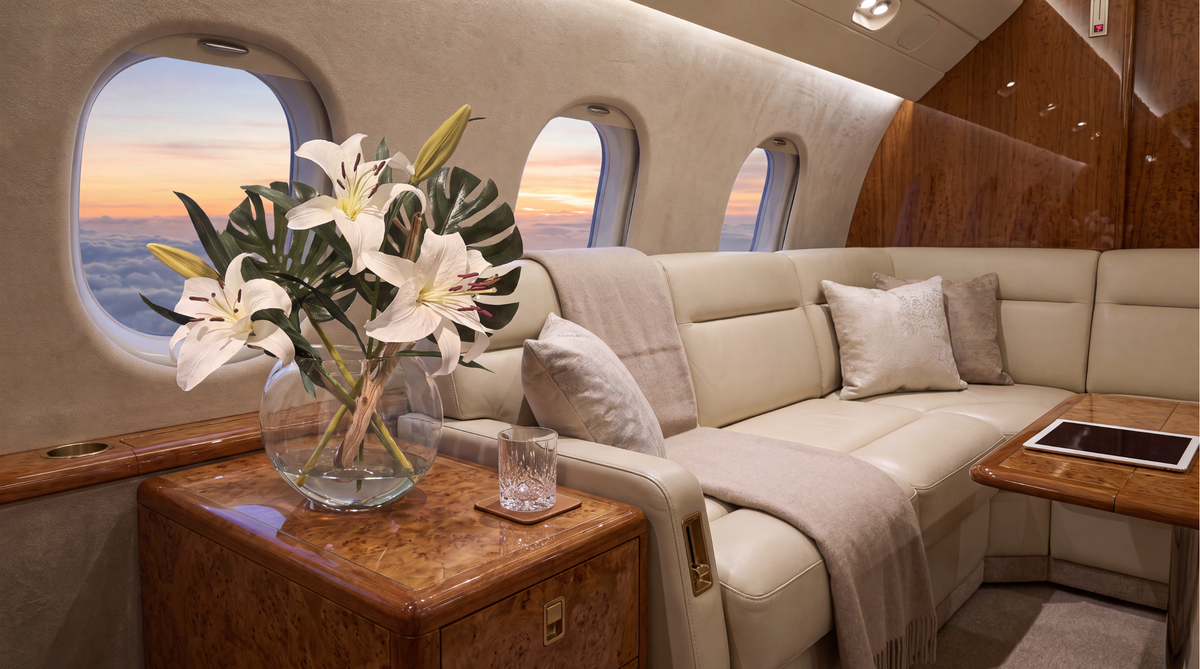
In my younger years, I had the privilege of working as a manufacturing/ quality engineer building systems for aerospace/ defense and aviation applications.
It taught me that innovation is rarely the act of adding something new. More often, it is the discipline of removing recurring failure, unnecessary motion, avoidable maintenance and waste from a system.
That perspective became so deeply wired into my central nervous system and it has shaped how I have built Jardin Du Monde
At first, botanical art and aircraft engineering may appear to occupy entirely different worlds. One is associated with beauty, atmosphere and human emotion. The other is governed by safety, repeatability, weight, documentation and performance.
But private aviation has never accepted that distinction.
The finest cabins are expected to be both technically exact and emotionally complete. They must withstand the realities of flight while feeling increasingly like private residences, hotel suites and yacht interiors.
This creates an interesting question:
If fresh flowers remain one of the most familiar ways to make a private cabin feel gracious and personal, why has the system for bringing them aboard changed so little?
The Hidden Operating Cost of Fresh Flowers
Fresh flowers offer an immediate sense of hospitality. They communicate that the aircraft has been prepared for a particular owner, passenger or journey.
But the beauty is temporary, while the operational demands repeat.
Fresh arrangements must be ordered, transported, received, conditioned, arranged and replaced. Their vessels must be cleaned. Their water must be monitored and refreshed. Deteriorating stems, petals and foliage must be removed. At the end of their brief service life, the entire composition becomes waste.
For aircraft operating across several cities or countries, consistency becomes another problem. The principal may prefer a particular flower, color or arrangement, but local availability, seasonality and florist capabilities can produce a different result at every departure point.
The cabin crew is left managing an aesthetic standard through a fragmented and perishable supply chain.
There are also international considerations. Travelers entering the United States must declare agricultural products, and admissibility can depend on species, origin and inspection. The USDA specifically treats cut flowers and greenery as agricultural commodities subject to entry requirements and inspection. USDA APHIS guidance
None of these issues makes fresh flowers inappropriate. There will always be occasions when their transience is part of their meaning.
But using them as the cabin’s default botanical solution deserves reconsideration.
A private aircraft may fly hundreds of missions over its interior’s service life. If a fresh arrangement is replaced before every mission or even several times a month, the cumulative purchasing, logistics, labor, water and disposal become significant.
The question is not whether fresh flowers are beautiful.
It is whether disposability should remain the price of botanical presence in a cabin designed around precision.
The Problem of Free Water in a Moving Environment
A fresh arrangement usually depends on an open or semi-contained reservoir of water.
In a residence, this is an ordinary condition.
Inside an aircraft, it introduces a variable.
The vessel may be moved during cabin preparation. Water can spill during taxi, turbulence, takeoff or landing. Even when the vase itself remains upright, water can migrate over the vessel’s edge if the fill level, arrangement density or motion is not carefully managed.
The immediate concern may appear cosmetic: a wet carpet, damaged veneer or stained upholstery.
But water in an aircraft cabin can be more consequential when it reaches seams, floor structures, attachment points, electrical interfaces or inaccessible areas where moisture is not immediately detected. Aircraft design standards therefore treat the relationship between electrical wiring and water systems seriously. EASA guidance, for example, requires appropriate separation so water leakage cannot create a hazardous condition for electrical wiring interconnection systems. EASA CS-25 guidance
A flower vase is not an aircraft water system. But the design principle remains instructive: unnecessary free liquid should not be introduced casually around sensitive materials and systems.
This is precisely where a maintenance-free botanical composition changes the equation.
It requires no standing water.
It introduces no irrigation line, drainage condition or recurring refill procedure.
It cannot wilt because the cabin was left in a hot hangar, and it does not rely on a crewmember remembering to replenish the vessel between missions.
The absence of water is not merely a convenience.
It is a design advantage.
The Arrangement Must Become Part of the Aircraft
Removing water solves only one part of the problem.
A botanical composition still possesses mass. During taxi, turbulence, takeoff, landing and emergency conditions, that mass must remain controlled.
A decorative arrangement cannot simply rest on a table because it appears stable during level flight. Transport-category aircraft requirements consider structural and occupant protection under defined inertia and emergency-landing conditions. 14 CFR §25.561
This suggests a different approach to botanical design.
Instead of thinking of the arrangement and the aircraft as separate objects, mounting interfaces can be introduced as one integrated system.
The concepts include discreet docking receivers engineered into an approved credenza, side ledge, partition or cabin monument where the botanical vessel would return to one exact location and orientation every time it was installed.
Magnets also help guide and index the vessels into that position.
The final retention, however, should not be assumed to depend upon magnetic attraction alone.
Permanent magnets may provide an elegant and intuitive docking experience, but their field strength, placement and proximity to aircraft systems would require evaluation. Magnetic effects and electromagnetic compatibility are established considerations in aviation environmental testing. The retention system would also need to demonstrate that the composition remains secure under the applicable aircraft loads.
Sustainability Must Be Measured Through Service Life
It would be easy to claim that maintenance-free botanicals are automatically more sustainable than fresh flowers.
That conclusion would be too simple.
The sustainability argument depends on service life.
A botanical installation becomes more compelling when it is designed to remain aboard for years, replaces repeated fresh-flower deliveries, eliminates standing water, avoids continual organic waste and can be repaired component by component.
Fresh-cut flowers can involve greenhouse energy, irrigation, refrigeration, packaging and air freight. Academic reviews of their environmental impacts identify energy consumption, water use, chemicals, transport and waste as important variables across the supply chain. Review of cut-flower lifecycle impacts
The responsible objective would not be to declare fresh flowers environmentally wrong.
It would be to offer aircraft owners durable, sustainable solutions that create value.
The strongest sustainability claim is not that the work is artificial, it is that the work is not disposable.
A Conversation Worth Bringing to the Summit
ALOFT AeroArchitects announced it will host the 2026 RedCabin Business Jet and VIP Interior Innovation Summit, taking place September 22–24, 2026, in Dewey Beach, Delaware. The forthcoming Business Jet and VIP Interior Innovation Summit will bring together Airbus Corporate Jets, Bombardier, Comlux, Greenpoint Technologies, completion centers, designers, engineers and material specialists to discuss certification, sustainable materials and ideas moving among aviation, yacht and residential interiors. Summit information
This is exactly the kind of cross-industry conversation such a summit should encourage.
ALOFT AeroArchitects’ development of its Modular Open-Source Architecture In-Cabin framework is particularly relevant to this conversation. MOSAIC is intended to support interoperability, flexibility and future technological upgrades without requiring complete system overhauls. ALOFT describes this philosophy as a path toward more adaptable and sustainable cabin systems.
The same principle can inform botanical integration.
Residential and hospitality design understand how flowers establish arrival, care and atmosphere.
Superyacht design understands the importance of secure objects, discreet crew service and maintainability within a moving environment.
Aviation understands that every beautiful idea must ultimately become a controlled and supportable system.
The opportunity is not to place a residential flower arrangement inside an aircraft.
It is to redesign botanical hospitality around the realities of flight.
A successful result would produce no standing water, no wilting inventory, no petals for the crew to remove and no unsecured vessel to stow before takeoff.
It would offer a defined service life, a controlled mounting interface and a composition that could be removed, inspected, repaired and returned to its exact position.
Not simply a flower that looks permanent.
A botanical system designed to belong aboard.
For me, it is exciting to see where two chapters of my life come together: the engineering discipline that first shaped my career and the botanical artistry that now defines my work.


