

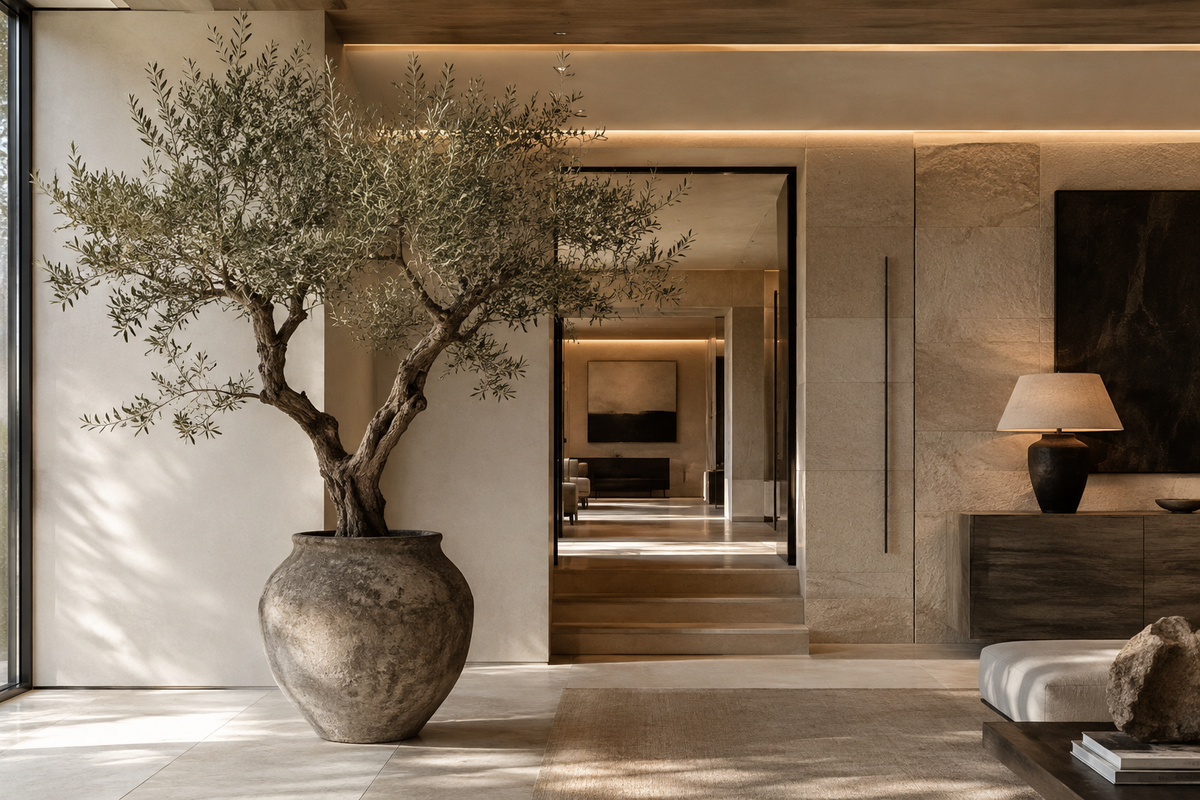
There is something unique about an old olive tree.
Very little about it is perfect.
The trunk twists. One branch extends more gracefully than another. The canopy grows dense in one place and unexpectedly open in another. Leaves overlap, turn away, and leave irregular pockets of light between them.
And somehow, all of this disorder feels completely right.
Perhaps that is what makes faux olive trees so interesting in interiors. Their presence is about more than recreating a living tree. They introduce something fundamentally different into spaces shaped by straight lines, measured proportions, and carefully controlled materials.
Architecture gives a room order.
Nature introduces irregularity.
And the conversation between the two can give a room character.
Key Takeaways
- Natural character comes from variation, not perfection. Asymmetry, irregular branching, and varied foliage give olive trees their distinctive presence.
- Botanical forms create contrast with architecture. Organic lines interrupt the controlled geometry of stone, glass, millwork, and furniture.
- Negative space matters. An open canopy lets light, architecture, and surrounding materials remain part of the composition.
- Placement should respond to the room. Faux olive trees should contribute to scale, sightlines, and spatial relationships rather than simply fill an empty area.
Why Does Nature Give a Room Character?
Look around almost any refined interior.
Stone is cut. Millwork aligns. Glass creates immaculate planes. Furniture follows deliberate proportions. Lighting is positioned with intent.
Even expressive architecture depends upon control.
Then place a tree inside it.
A tree introduces qualities architecture rarely produces on its own:
- Organic lines that bend and divide rather than follow a grid
- Asymmetry that creates visual tension without disorder
- Texture that contrasts with highly resolved surfaces
- Negative space that lets the room remain visible through the canopy
- The tree does not need to dominate the room to alter it.
Against limestone, an aged trunk can emphasize the solidity of the stone. Beside glass, irregular branches counter an immaculate surface. Among rectilinear furniture, an open canopy introduces lines that could never have been drawn with a ruler.
Character often emerges through these relationships.
Sometimes what a beautifully designed room needs is not another object.
It is contrast.
Why Is Imperfection Essential to an Olive Tree?

Nature contains patterns without perfect repetition. Olive trees develop asymmetrical branches, variations in foliage density, irregular trunks, and changing leaf orientations, giving each tree a unique silhouette.
An old olive tree carries evidence of time.
Some branches extend farther than others while sections of the canopy open unexpectedly. Mature wood twists and divides, and leaves face different directions as light moves across them.
None of these characteristics exists because the tree was trying to achieve a composition.
Yet together, they create one.
This offers an important lesson for faux olive trees. Botanical realism is not simply a matter of reproducing a trunk, branches, and correctly colored leaves. Everything can be technically present and still feel artificial when it is too evenly distributed.
A convincing interpretation pays attention to:
- irregular rather than evenly spaced branching
- variation in leaf direction and foliage density
- believable relationships between trunk and canopy
- asymmetry in the overall silhouette
- open spaces between branches and leaves
Those empty spaces matter.
They reveal the structure beneath the foliage, allow daylight through, and keep surrounding architecture visible. A tree can therefore have significant scale without becoming a solid visual mass.
The objective is not disorder for its own sake. It is controlled irregularity.
Imperfection is not the absence of order.
It is order without boundaries.
How Should Faux Olive Trees Relate to Architecture?
Faux olive trees should be considered in relation to ceiling height, furniture proportions, sightlines, circulation, surrounding materials, and available space. The right tree is not simply convincing on its own; its scale and structure should make sense within the room.
A beautifully interpreted tree can still feel wrong in the wrong environment.
A small olive tree may disappear against monumental architecture. An excessively dense canopy can interrupt an important view. A broad specimen may compete with furniture or circulation even when its height appears appropriate.
Before selecting a botanical composition, consider:
- Scale: Does it have enough presence for the volume of the room?
- Sightlines: Will the canopy frame or obstruct important views?
- Proportion: How do its height and width relate to nearby furniture?
- Circulation: Can people move comfortably around the tree and vessel?
- Material context: How will it relate to surrounding stone, timber, metal, or glass?
This is why botanical placement should begin with the room.
Perhaps a long horizontal space needs vertical movement. A large stone wall may need an organic counterpoint. A window may benefit from being framed without obscuring the landscape beyond it.
These are different spatial needs, and they should not automatically produce the same tree.
The question is no longer simply:
Where can the tree fit?
It becomes:
What changes about the room when the tree is there?
When Does Botanical Design Become Bespoke?

Bespoke botanical design becomes relevant when a space requires a particular scale, silhouette, canopy density, vessel, or relationship to architecture that a ready-made tree cannot provide.
Not every interior requires a custom piece. Sometimes an existing faux olive tree already has exactly the right proportions and character.
Other environments ask more specific questions.
An important sightline may need to remain unobstructed. An unusual ceiling height may require a particular botanical scale. A narrow footprint may restrict the canopy and vessel. Materials already established in the room may call for a more considered relationship between the botanical composition and its surroundings.
In these situations, botanical design moves beyond selection.
The tree is considered not only for what it looks like, but for what it contributes to the environment.
That is the difference between occupying space and belonging to it.
The Character of Imperfection
Perhaps nature does more for an interior than make it beautiful.
It introduces something architecture cannot completely manufacture: irregularity without disorder, referring to when a branch divides or a trunk twists in different directions.
Nothing is perfectly balanced, yet the whole somehow finds balance.
The most considered faux olive trees preserve something of this character—not by creating a flawless version of nature, but by observing what makes an olive tree distinctive and how those qualities can enter into dialogue with architecture.
At Jardin du Monde, botanical compositions are considered through scale, structure, density, negative space, sightlines, vessels, and material context.
Because sometimes what gives a perfectly designed room character is the thing that refuses to be perfect.
Frequently Asked Questions About Faux Olive Trees
Q: What makes faux olive trees look realistic?
A: Realistic faux olive trees combine natural proportions, irregular branching, varied foliage, and asymmetry. Excessive repetition can make a tree feel less natural because living trees contain variation.
Q: How do faux olive trees add character to a room?
A: Their organic lines, texture, asymmetry, and negative space create contrast with geometric furniture and architectural materials such as stone, glass, timber, and metal.
Q: Where should a faux olive tree be placed?
A: Place it where it warms the room—introducing height, balancing architectural mass, softening geometric surfaces, or framing a view—rather than simply filling an empty corner.
Q: What size faux olive tree should I choose?
A: Consider ceiling height, canopy width, furniture proportions, circulation, and surrounding space. The tree should have enough presence to complement the architecture without overwhelming it.
For interior designers, architects, hospitality teams, yacht designers, and private clients considering bespoke faux olive trees and other permanent botanical works, Jardin du Monde offers private design consultations to explore what the architecture requires.


