

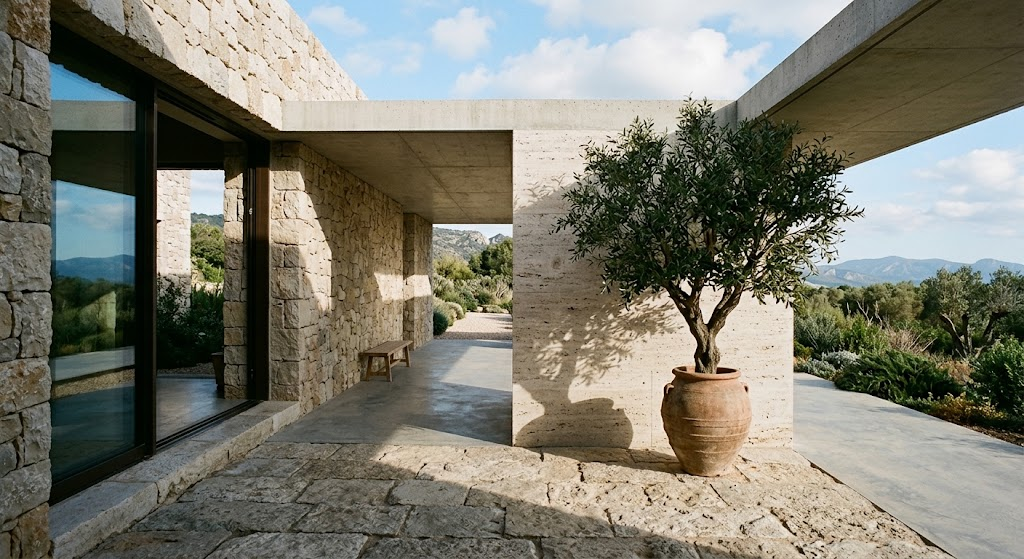
Before there were courtyards, there was stone.
Limestone beneath an open sky. Travertine walls holding back the landscape. Concrete planes reaching outward until structure seemed to dissolve into the horizon.
Architecture begins with control.
A wall frames a view. Glass invites light inside. A roof creates shadow where none existed before.
But architecture eventually reaches its edge.
Stone can catch the afternoon sun, but it cannot soften it. Glass can reveal the landscape, but it cannot give that view depth on its own.
That is where botanical form enters.
Sometimes it grows. Sometimes it changes with the seasons. And sometimes, outdoor artificial plants provide a more permanent silhouette where the architecture depends on consistency.
The interesting question is not where to put the plant.
It is what happens to the space once it is there.
The Glass House: When Landscape Becomes Part of the Room
Philip Johnson's Glass House makes the surrounding landscape impossible to ignore.
The architecture is stripped back to floor, roof, columns, and glass. Almost everything beyond those planes becomes part of the interior experience.
A tree outside the window is no longer simply landscaping.
Its trunk breaks the horizon. Its canopy gives scale to the glass. The open ground around it creates distance and calm.
A View Can Be Designed Like a Room
The same principle applies to contemporary homes with large windows.
From a sofa or dining table, an exterior plant may be viewed more often through glass than from the terrace itself.
Its position can:
- Frame a distant view
- Balance a window opening
- Align with a column
- Soften a blank wall
- Mark the end of a sightline
This is where a permanent botanical form becomes useful.
A designer can select a precise height, canopy width, and visual density. The relationship between the plant and the architecture can remain relatively stable.
The plant begins to behave less like decoration and more like part of the drawing.
Fallingwater: Where the Threshold Begins to Disappear
Fallingwater tells a different story.
Frank Lloyd Wright did not simply place a house beside nature. He pushed the building into it.
Terraces stretch outward. Stone moves between interior and exterior spaces. Glass opens the rooms to the surrounding forest.
The house seems to ask where architecture ends, and landscape begins.
There is no simple answer.
Interior and Exterior Can Share One Visual Language
Modern homes often attempt the same continuity.
A limestone floor continues beyond sliding glass. A ceiling extends into a covered terrace. Furniture is positioned toward the view instead of away from it.
Botanical forms can continue that sequence.
An interior tree might be echoed by another form beyond the glass. Similar planters might appear on both sides of the threshold.
They do not need to match exactly.
They simply need to feel related.
With outdoor artificial plants, placement can follow the visual composition rather than natural growing conditions alone.
The sightline decides where the form belongs.
At the Getty, Stone Meets Change
The Getty Center presents another relationship between architecture and planting.
Its pale stone feels permanent and ordered.
The landscape does not.
Trees move in the wind. Gardens shift through colour and season. Shadows change across the travertine throughout the day.
That tension gives the place energy.
Stone remains.
Landscape changes.
Neither approach is better. They simply create different experiences.
What Happens When the Design Needs More Control?
Imagine a formal courtyard with two matching trees framing an entrance.
At installation, the composition is perfectly balanced.
Over time, one tree grows wider. The other reaches toward stronger light. Their silhouettes slowly separate.
That change may be beautiful.
But it is no longer the original composition.
Some spaces are designed around exactly that kind of natural evolution.
Others depend on a more controlled visual rhythm.
For those projects, permanent botanical forms are a perfect solution that can preserve scale, symmetry, and proportion with greater consistency.
The Shadow May Be More Important Than the Plant

Late in the afternoon, a plain wall can suddenly become the most interesting surface in the space.
The sun lowers, a branch interrupts the light, and all of a sudden, its shadow stretches across stone.
Nothing structural has changed, but the architecture feels different.
Botanical Form Shapes More Than Empty Space
Different silhouettes create different shadows.
- Broad leaves produce strong graphic shapes.
- Fine foliage creates softer patterns.
- Open branches allow light to pass through.
- Tall forms stretch across floors and paving.
This changes how botanical placement should be considered.
The plant itself is only half the composition.
The other half is the wall behind it, the stone beneath it, or the glass beside it.
A carefully positioned form can animate a surface without adding another architectural element.
Scale Is Felt Before Detail
Walk into a double-height loggia with a small plant in one corner.
It disappears.
Place a strong vertical tree in the same position, and the room immediately feels different.
The building has not changed.
Its perceived proportions have.
The Eye Reads Silhouette First
From a distance, we notice:
- Height
- Width
- Density
- Shape
- Visual weight
Leaf detail comes later.
That is why the success of outdoor artificial plants in architectural settings depends heavily on scale.
A large terrace may need one substantial form rather than several small ones.
A narrow courtyard may need the opposite.
The planter matters too.
A tree and its container should be read as one visual object. The planter gives the botanical form weight and connects it to the materials around it.
Restraint Gives the Silhouette Power
Strong architecture rarely needs every empty corner filled.
The Glass House depends on open views.
Fallingwater allows the landscape to remain dominant.
The same restraint can strengthen botanical design.
One tree may be enough.
Two forms may complete an entrance.
A single sculptural plant may hold the end of a long pool.
Empty Space Is Part of the Composition
A botanical element should have a reason to exist.
It might:
- Frame
- Anchor
- Soften
- Screen
- Balance
- Direct the eye
If it does none of those things, the space may be stronger without it.
This matters especially with artificial planting.
The goal should not be to fill the exterior with greenery.
It should be to create one deliberate relationship between form and architecture.
From Outdoor Artificial Plants to Architectural Elements

The phrase artificial plants can sound purely decorative.
Something added after the major design decisions have already been made.
But their architectural use begins much earlier.
The botanical form can be considered alongside walls, windows, materials, furniture, and light.
It can soften stone without hiding it.
It can frame a view without building another wall.
It can introduce organic form into rigid geometry.
And it can cast a shadow across a surface that would otherwise remain still.
That is the difference between decoration and design.
Decoration occupies space.
Design changes how the space is experienced.
The Last Line of the Drawing
Every architectural drawing eventually stops.
The wall ends.
The terrace meets open air.
The roof gives way to sky.
But the experience continues beyond those lines.
The Glass House shows how landscape can become part of an interior.
Fallingwater shows how structure can reach toward its surroundings.
The Getty reveals the tension between permanent architecture and changing landscape.
Their lesson is not to copy them.
It is to notice what happens beyond the building itself.
What the window frames.
Where shadow falls.
How the eye moves.
For some projects, living landscape completes that story.
For others, outdoor artificial plants offer a controlled botanical silhouette.
Either way, the strongest exterior spaces begin with the architecture.
Then, somewhere between stone and sunlight, the final form finds its place.
Decorate your place with our artificial plants and more at Jardin Du Monde today!
Frequently Asked Questions
Q: Can outdoor artificial plants work in luxury architecture?
A: Yes. Proportion, material quality, and placement matter more than quantity. The best examples feel integrated into the architecture.
Q: Why use artificial plants instead of living plants?
A: They provide greater consistency in shape and placement. This can help in shaded, symmetrical, or highly controlled spaces.
Q: Can artificial plants connect indoor and outdoor spaces?
A: Yes. Repeating similar silhouettes or planter materials can extend an interior composition beyond the glass.
Q: Are outdoor artificial plants suitable for minimalist spaces?
A: Yes. One carefully chosen form can soften hard materials without overwhelming simple geometry.
Q: Does sunlight affect outdoor artificial plants?
A: Yes. Products should suit the exposure of the site, including sunlight, heat, wind, and rain.
Q: Is one large plant better than several smaller plants?
A: It can be in architectural spaces. One strong silhouette often creates more impact while preserving valuable negative space.


