

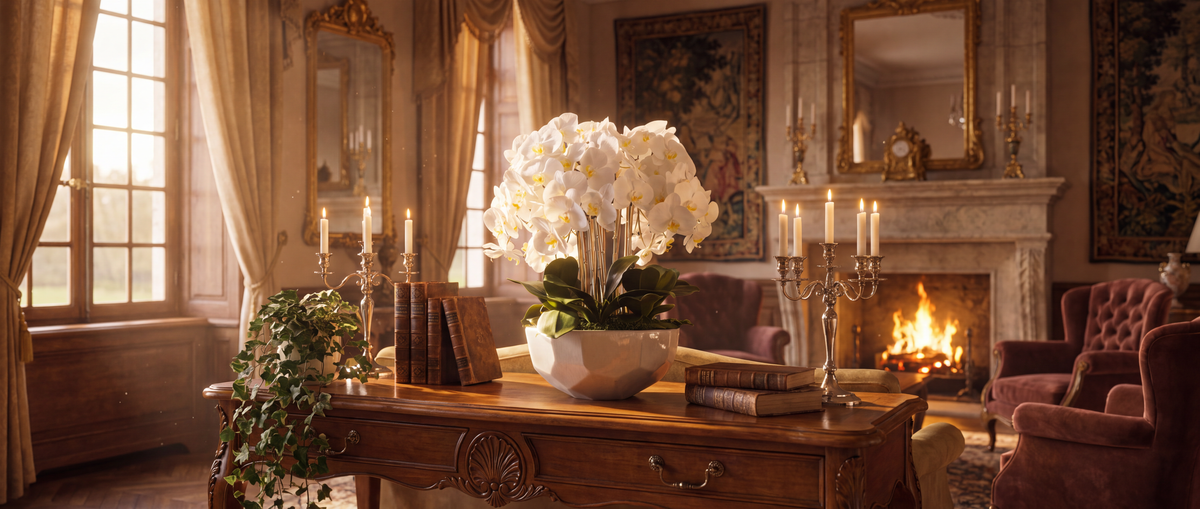
Do you remember watching the chaotic symphony of your parents preparing the house for company?
Perhaps you were small enough that the dining table seemed enormous.
Mom carefully set the table with fine china. Crystal glassware appeared from a cabinet that was rarely opened.
Flowers were cut shorter before being placed into a vase. Light music echoed through the halls from another room. The lights were lowered slightly, not enough that anyone would consciously notice, only enough to change the mood of the room.
And Mom told you not to touch ANYTHING.
So you sat on the stairs and watched.
There are moments we learn from before anyone thinks to call them lessons.
No one stopped to explain why the flowers belonged there, why certain plates were chosen, why the good linen came out for guests, or why the room somehow felt different when everything had been placed just so.
And yet, somehow, you were learning.
Years later, you might find yourself preparing your own home to welcome friends and family.
You straighten a chair and arch a calla lily stem in a vase.
You dim a lamp.
And something about the room finally feels right.
But who taught you that?
 Art deco dining room- Private Residence | Atlanta, GA
The things we mistake for instinct
We tend to speak about taste as though it arrives fully formed.
Someone has it, or they don't.
We describe a person as having an eye for proportion, an appreciation for architecture, an instinct for flowers, an understanding of beautiful materials. We say that someone simply knows when a room is right.
But perhaps very little about taste is simply instinct.
The French sociologist Pierre Bourdieu spent much of his work questioning precisely this assumption.
Bourdieu argued that our preferences do not develop in isolation. They emerge from a lifetime of exposure—to family, education, class, geography, culture, architecture, language, rituals and the thousands of seemingly insignificant experiences that accumulate around us.
He called part of this habitus.
Habitus is difficult to translate neatly because it describes something we rarely notice happening: the slow transformation of environment into intuition.
The things surrounding us become familiar.
The familiar becomes comfortable.
And eventually, comfort begins to feel like preference.
What we have learned begins to feel like something we have always known.
Taste, viewed this way, is less an instinct than an inheritance of attention and authenticity.
The house remembers before we do
Consider the places you remember from childhood.
It is strange how rarely memory preserves an entire room.
Instead, it keeps fragments.
The coolness of a stone floor beneath bare feet or the smell of jasmine outside an open window.
The things that remain are often remarkably ordinary.
And perhaps that is precisely why they remain.
They were repeated, ritual, and existed around us so consistently that we stopped consciously seeing them.
Bourdieu understood that environments do more than reflect our preferences. They participate in forming them.
This complicates one of the central assumptions of interior design.
We often say that a home should express who you are.
But what if that relationship also moves in the opposite direction?
What if the places we inhabit are quietly teaching us who to become?
The home as an education
A room is never entirely passive.
Architecture teaches us scale.
Materials teach us permanence.
Craftsmanship teaches us patience.
Art teaches us observation.
Gardens teach us seasonality.
Empty space teaches us restraint.
Nature teaches us something more difficult still: that beauty does not require perfection.
None of these lessons needs to be spoken aloud.
A child raised among books does not need a lecture on the importance of reading to understand that books matter.
A child who watches someone care for a garden learns that beauty sometimes requires waiting.
Someone surrounded by objects repaired rather than discarded develops a different relationship with permanence.
Someone who grows up watching a table carefully prepared before people they love arrive begins to associate beauty with hospitality rather than display.
The room becomes a teacher.
And the lessons are absorbed long before anyone thinks to call them lessons.
 Beverly Ann's Cherry Blossom Paradise - Parker Residence | Old Westbury, NY
The complicated inheritance of taste
There is, however, another side to Bourdieu's thinking that is important not to romanticize.
Taste is not culturally innocent.
In Distinction, Bourdieu challenged the idea that society's definitions of refinement and “good taste” simply reflect superior aesthetic judgment. Our preferences can also reveal education, access, social position and the cultural environments into which we were born.
Knowing which artist to recognize, which wine to order, which chair matters, which hotel is discreet enough not to announce itself—these forms of knowledge can operate as cultural currency.
Bourdieu called this cultural capital.
And once we understand that, luxury becomes considerably more interesting.
Because the question is no longer simply:
What is expensive?
It becomes:
What have we learned to recognize as valuable?
Those are very different questions.
Perhaps this helps explain why some of the most extraordinary interiors contain remarkably little that announces its own importance.
Their sophistication is found elsewhere.
In proportion, materiality, or the confidence to leave something empty.
In the relationship between architecture and landscape.
It is found in understanding that a room does not become more meaningful simply because another beautiful object has been added to it.
There is a quiet form of discernment in knowing when enough has already been said.
Perhaps nature is part of our habitus, too
I may have my own bias opinions, but we can all agree that there are plants we recognize before we know their names.
An olive tree can transport someone to summers spent along the Mediterranean.
Bougainvillea spilling across stucco can recall a place visited decades earlier.
Palms can become inseparable from the feeling of arriving somewhere warm.
An orchid can remind us of the entry table in a childhood home.
These associations are deeply personal.
Two people can look at the same tree and see entirely different things.
One sees an object.
The other remembers a life.
Perhaps this is why botanical elements can hold such unusual emotional power within architecture.
We rarely remember them as decoration.
We remember what happened around them.
 Cozy Breakfast Nook- Wimbledon Residence | Napa Valley, CA
Designing for memory
This idea sits quietly at the center of Jardin du Monde.
We have never been particularly interested in placing plants into rooms simply because an empty corner appears to require one.
We are interested in something more difficult to articulate.
Belonging.
The emotional register of the space before anything botanical is introduced.
Only then does the question become what might belong there.
Sometimes that answer is a single ancient-looking olive tree whose imperfect trunk gives a pristine room something it cannot manufacture: the suggestion of time.
Sometimes it is a canopy large enough to change the perceived scale of an atrium.
Sometimes botanical forms soften the severity of stone and glass or they introduce the memory of a landscape beyond the walls.
And sometimes their greatest contribution is almost impossible to identify.
The room simply feels more complete.
That distinction matters.
Because the ambition should never be for someone to walk into a space and immediately notice the botanical installation.
Perhaps the greater compliment is that, after enough time, they stop noticing it altogether.
It simply belongs.
It becomes part of breakfast in the morning or conversations after dinner.
Part of walking through the room barefoot at night.
Part of birthdays, visitors, arguments, celebrations and ordinary Tuesdays.
Eventually, it enters the background of life.
And the background of life is often where memory is made.
What luxury leaves behind
Perhaps we have spent too much time defining luxury by what can be acquired.
There is nothing inherently wrong with beautiful things. Objects can contain extraordinary craftsmanship, history and human ingenuity.
But possession alone cannot create meaning.
Meaning requires relationship.
It requires time.
This may be why the most compelling spaces often resist immediate explanation.
They reveal themselves slowly.
A hand-carved surface becomes more beautiful after you understand how it was made.
A chair becomes more meaningful after thousands of mornings spent sitting in it.
Perhaps the highest expression of luxury is not recognition at all.
Perhaps it is intimacy.
To live among things chosen carefully enough that eventually you no longer experience them as possessions.
They simply become part of your life.
What will they remember?
There is a temptation, when designing a home, to think primarily about the present.
But Bourdieu gives us reason to ask a more consequential question.
What is this room teaching?
Because someone is watching.
A child sitting at the end of the table.
A friend visiting for the first time.
A daughter cutting flowers before dinner.
A son watching someone carefully return an object to its place.
Or perhaps simply you, moving through the same rooms every morning, absorbing their proportions and rituals until you no longer consciously see them.
Years from now, very little of it may be remembered precisely.
The name of the stone may disappear.
The designer of the chair may be forgotten.
But someone may remember the afternoon light.
The tree beside the window.
The feeling of being welcomed.
The peculiar calm of a room where everything seemed to belong.
And perhaps that is what we misunderstand about taste.
We think we are choosing the things that surround us.
All the while, they are quietly becoming part of us.


