

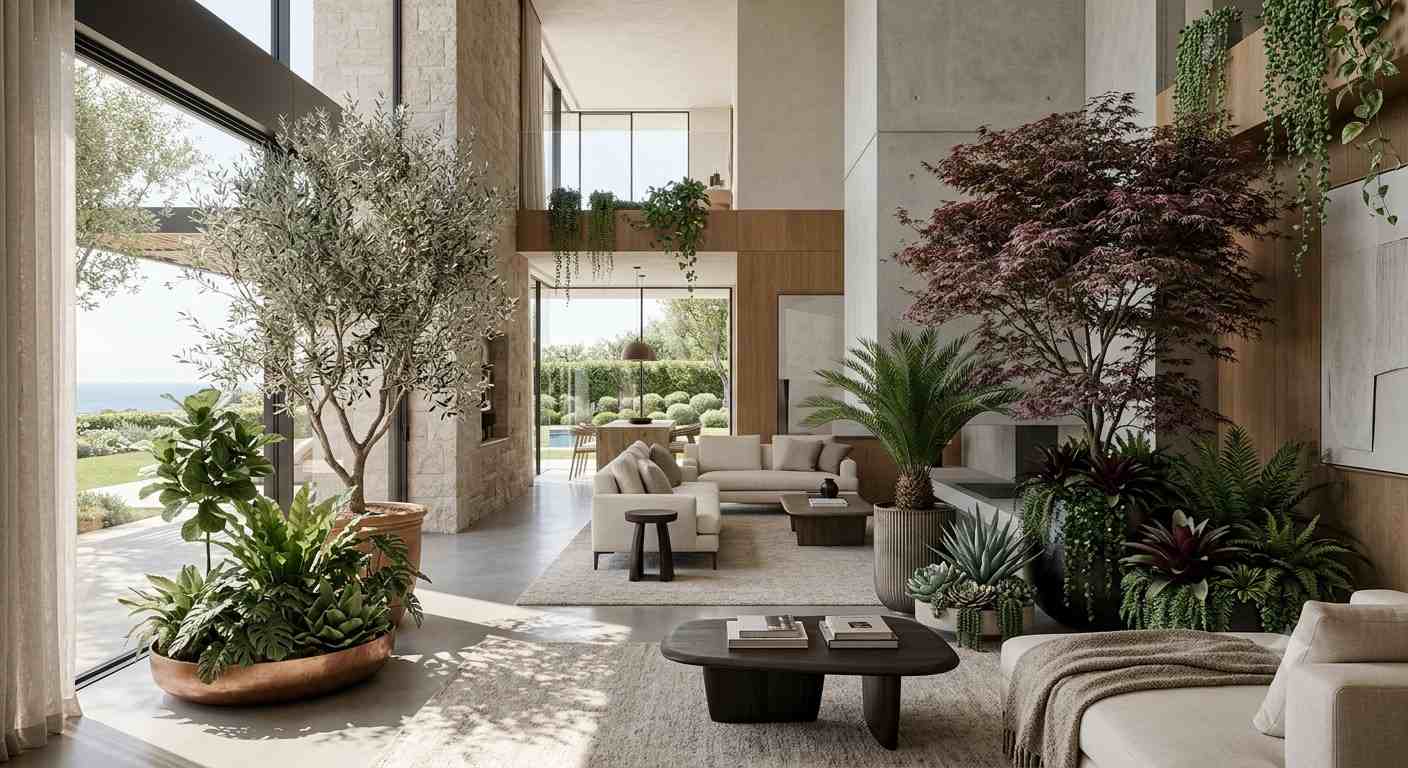
Soaring ceilings and expansive glass facades define modern luxury architecture, yet they create environments hostile to living flora. Consequently, inconsistent sunlight and indoor climate control make maintaining a towering living tree a logistical battle. This reality has driven elite designers to transition to high-fidelity permanent botanical art. Ultimately, incorporating luxury artificial trees into an interior or exterior landscape allows sophisticated projects to establish structural permanence and flawless, year-round elegance without compromising visual excellence.
Key Takeaways
- Architectural Anchor: True luxury permanent trees serve as foundational structural design elements rather than simple background decor. Specifically, they provide essential scale and organic asymmetry to grand spaces without the maintenance challenges of living flora.
- Premium Material Standards: High-fidelity botanicals completely discard cheap plastics in favor of real, cured timber trunks and real-touch polymers. As a result, this meticulous craftsmanship ensures that every individual piece features a unique and highly accurate natural texture.
- All-Weather Engineering: Exterior variants utilize core-infused UV inhibitors and heavy-duty inner steel armatures to withstand extreme elements. Therefore, this durable design prevents foliage fading and structural damage on exposed penthouse terraces or poolside decks.
-
Seamless Botanical Flow: Aligning the plant species between indoor rooms and outdoor loggias creates a unified visual extension that doubles a property's perceived footprint. By implementing this design strategy, designers maintain a flawless aesthetic across the entire estate through every season.
The Evolution of Permanent Botanical Artistry
But to be in keeping with an editorial, couture aesthetic, a permanent display has to shake off all associations of old mass-market plastic plants. Instead, genuine luxury artificial trees are works of art, delicately constructed to focus on botanical replication, organic irregularity, and architectural durability.
Key Luxury Design Features
True luxury faux trees are defined by several essential craftsmanship standards:
Genuine Preserved Natural Timbers
The top-grade manufacturing construction consists primarily of true salvaged organic timber trunks. Furthermore, harvested and cured sustainably, these natural trunks preserve their raw bark surface, organic twists, and age rings. This guarantees that each tree stays true to type; hence, no two specimens are the same.
The Real-Touch Thresholds
Super high-end foliage utterly rejects the gleaming, homogenous plastic look you see with lower price points. Rather, it uses high-end polymers of polyurethane and silk-blend that imitate the touch, soft, vein-styled texture of a live leaf with coolants. Accordingly, the light reflected in the lignin, even closely inspected, has a soft and natural matte finish.
Controlled Imperfection
Nature is beautifully flawed. In this way, high-fidelity permanent trees mirror this reality by featuring variable foliage density, young new-growth leaves at the branch tips, and multi-toned gradients that mimic a life spent turning toward the sun.

Curation: Shaping the Grand Foyer and Fine Interiors
When designing for indoor grand spaces, the primary rule is scaling to match the architecture. For example, a standard six-foot tree disappears when placed underneath a vaulted or double-height ceiling. Thus, elite spaces demand monumental, sculptural statements.
|
Botanical Choice |
Visual Pairing |
Best Structural Placement |
|
Mediterranean Olive |
Reclaimed Limestone & Travertine |
Expansive, light-filled marble foyers |
|
Japanese Maple |
Sleek Polished Concrete & Terrazzo |
Contemporary minimalist living rooms |
|
Ficus Benjamina |
Aged Italian Terracotta Urns |
Traditional European-style sunrooms |
Species Spotlight for Luxury Homes
- Mediterranean Olive: Finally, to give your home that sophisticated European appeal, but with light, airy warmth. The iconic silvery-gray-green foliage casts gentle shadows across wide swaths, thereby anchoring minimalist spaces without being assertive.
-
Architectural Japanese Maple: When your interior calls for a structured, classical geometry, go grand with an imposing Ficus Benjamina or Architectural Japanese Maple that has layered, multi-dimensional canopies that provide notes of texture against the starkness of modern designs.
The Designer's Curation Tip
Crucially, a luxury artificial tree must never remain in its black plastic starter pot. Designers slip-pot these installations into heavy museum-grade vessels—such as hand-thrown Italian terracotta, raw concrete planters, or antique stone urns. Then, to complete the illusion, pack the base with real preserved forest moss, dark river stones, or aged French mulch, anchoring the tree into the room's design layout.
Designing Spaces with Luxury Artificial Trees
The modern estate does not stop at the glass doors; instead, it flows onto loggias, limestone terraces, outdoor kitchens, and poolside decks. However, managing living outdoor trees in exposed areas introduces constant challenges. For instance, strong penthouse winds, intense UV exposure, and shifting seasonal temperatures frequently leave living landscape designs looking thin, scorched, or entirely bare.
Fortunately, this climate reality is where weather-engineered exterior artificial trees excel, offering flawless curb appeal and pristine structures 365 days a year.
The Science Behind Outdoor Longevity
While interior faux trees focus on tactile softness, exterior versions are triumphs of materials science:
- Infused UV Protectant: Most faux plants offer only a simple UV coating spray on the surface, which wears off with rain, causing the leaves to fade or discolor in the very first season. In contrast, identical flooring trees for the outdoors attain true exterior luxury via integral pigments. UV-inhibiting chemicals are blended right into the high-density polyethylene polymer throughout molding, simultaneously creating colours resembling rich forest greens and deep verdigris tones to prevent fading from solar rays.
-
Robust Infrastructure: These exteriors are built on heavy-duty, galvanised steel armatures and water-resistant fiberglass cores. As such, they withstand high-altitude winds battering skyscraper balconies or seasonal torrential downpours without breaking their form and even without shedding branches.
Strategic Exterior Applications
- Elite Penthouse Terrace: Top floors' balconies are wind microclimates that rip real plants to shreds. However, no structural soil or complex irrigation systems needed; these “living walls” provide instant architectural privacy by framing an outdoor lounge and are easy to set up as structural faux Italian Cypresses or manicured Boxwood Topiaries.
-
The Beauty of the Poolside: Live trees continually shed sap, leaves, and aggressive roots that can wreck expensive pool liners or overwork filtration systems. On the other hand, a high-fidelity faux Areca or Kentia Palms gives you a crisp, resort-like look without any pool stain contamination or leaf clearing maintenance—it looks just the same!
Designing with Jardin du Monde Heritage
When selecting permanent greenery, incorporating the design philosophy of an established botanical authority ensures cohesive aesthetic execution. For example, for those drawn to the romanticism of European estates, referencing the curation and plant profiles found at Jardin du Monde serves as an excellent blueprint. Known for celebrating historical European arboriculture, their focus on traditional varieties thus provides the perfect framework for choosing high-fidelity permanent equivalents.
Implementing the "Visual Extension" Rule
Here are a few design tricks you can use to create that smooth indoor-outdoor transition:
- Align the Species: If your interior dining space opens out through a wall of glass onto an open terrace, create the visual continuity in materials and style by placing an interior luxury faux Olive tree next to a set of weather-resistant outdoor Olive trees directly outside onto the limestone patio.
-
Create Spatial Symmetry: This strategy visually obscures the lines of the home and essentially doubles what looks like the footprint of the estate while giving it a scrubbed appearance that requires little or no upkeep.
Summing Up
In conclusion, investing in premium luxury artificial trees that are well-structured gives designers and homeowners complete control over their environment. Ultimately, it can seemingly preserve the same classic natural beauty (and grand scale of architecture) while maintaining a perfectly manicured look across all four seasons.
Frequently Asked Questions
Q: How do you clean and maintain high-end artificial trees?
A: Luxury permanent botanicals require very little regular cleaning. However, to maintain quality and prevent dust from building up on the petals and leaves, it is recommended that you use a feather duster once every 3-4 months. Alternatively, wipe the foliage lightly with a microfiber cloth or give it an occasional go with a feather duster, ideally once a month. Lastly, to remove the dust that settles on the bark and branch joints, soft artist's paintbrushes are great for delicate, real-touch textures.
Q: Do luxury artificial trees come already potted in decorative planters?
A: Most premium faux trees arrive stabilized in a weighted, black plastic nursery starter pot. However, this basic foundation is designed specifically to be placed inside a larger, decorative vessel of your own choosing. This allows you the design freedom to match the final planter perfectly to your property's unique interior or exterior architecture.
Q: How do you properly shape or "fluff" a luxury tree after unboxing it?
A: High-end trees are packaged for transport, and this means the canopy will look compressed on unpacking. You will begin with the lower branches and work your way upward while gently finger-bending the wired steel armatures outward and downward into an organic, full silhouette. While making your farm to simulate realistic plant growth, be sure not to make a perfect shape.
Q: Can luxury indoor artificial trees be used outside on a covered patio?
A: Indoor greenery is made from fabrics that are soft to the touch but will rapidly deteriorate or fade in moisture, wind, and ambient UV light. Therefore, for terraces, loggias, or pool decks: always ask for variants constructed with UV-inhibitors infused into the core and trunk made of weather-resistant fiberglass.


