

Modern commercial architecture treats greenery as an essential structural element. It shapes visitor behavior and defines spatial flow. However, introducing living flora into high-traffic interiors presents severe logistical and financial liabilities. This is due to inadequate natural light and constant maintenance disruptions.
Consequently, this friction has fueled the rise of permanent botanical landscaping. Designing commercial spaces with premium, realistic faux plants offers a strategic alternative. It allows architects to capture the aesthetic benefits of nature with absolute permanence. Best of all, it guarantees zero operational friction.
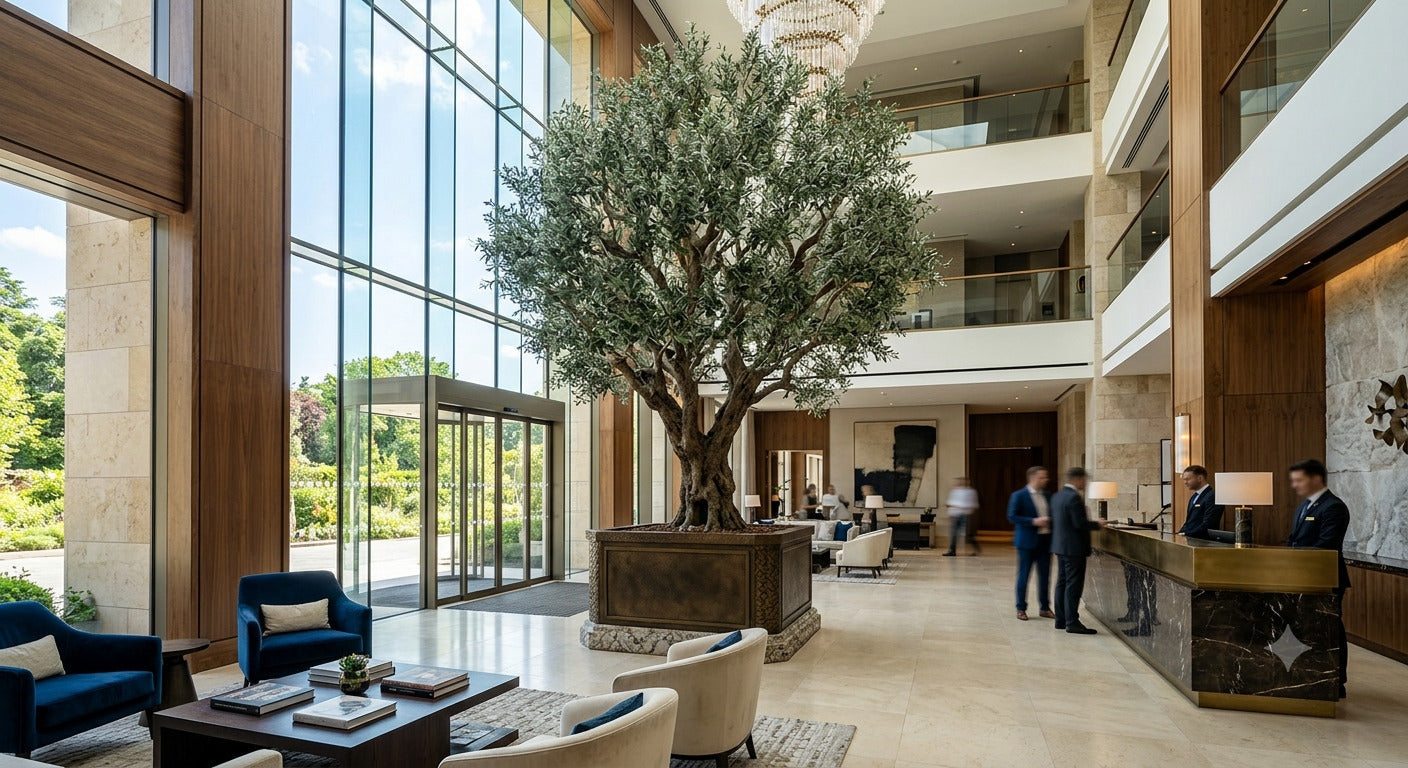
A soaring, multi-story luxury hotel lobby featuring floor-to-ceiling glass, a grand chandelier, and a massive, realistically crafted artificial olive tree in an ornate planter as its central anchor.
Key Takeaways
- Strategic Brand Elevation: High-fidelity permanent botanicals instantly communicate luxury and wellness. They also highlight a keen attention to detail.
- Overcoming Architectural Constraints: Premium faux plants allow designers to install massive green features anywhere. They work perfectly in low-light or weight-sensitive zones.
- Uncompromising Botanical Realism: Elite faux flora utilizes natural cured timbers and organic asymmetry. These elements completely transcend the mass-market plastic look.
- Drastic Cost Optimization: Transitioning to permanent landscaping eliminates ongoing specialized labor. It also cuts costs for replacement plants and water infrastructure.
The Strategic Power of Biophilic Commercial Design
Biophilic design connects building occupants more closely to nature. Today, it is a data-driven commercial necessity, not a luxury trend. Specifically, environmental psychology studies consistently show that visible greenery yields measurable returns. In corporate offices, it reduces employee stress and boosts cognitive productivity.
Meanwhile, in retail and hospitality environments, it increases customer dwell time. Longer visits directly correlate with higher average transaction values.
The Limitations of Living in Indoor Greenery
Historically, large-scale biophilic layouts required living green walls or heavy indoor trees. However, the commercial lifecycle of indoor living trees is notoriously short.
- Environmental Deprivation: Living trees experience cyclical leaf drop and structural thinning indoors. This is caused by a lack of UV rays and harsh HVAC systems.
- Aesthetic Degradation: Consequently, the foliage suffers from eventual browning. This creates an unappealing visual aesthetic that damages a business's premium reputation.
The Permanent Botanical Solution
Architects can reliably implement sweeping, multi-story botanical landmarks by using premium faux plants. Ultimately, these high-fidelity installations remain perfectly manicured from opening day onward. Their flawless appearance is completely independent of internal environmental conditions.
The Anatomy of Commercial-Grade Realistic Faux Plants
Permanent plants must pass the closest visual and tactile inspection. This keeps the design integrity of luxury showrooms, lobbies, and upscale restaurants intact. They must look entirely indistinguishable from their living counterparts. Achieving this standard requires meticulous material engineering and an artistic commitment to organic imperfection.
1. Naturally Sourced, Cured Timbers
Mass-market faux plants are easily spotted by their uniform, injection-molded plastic trunks. Conversely, premium realistic faux trees utilize real, salvaged natural wood trunks.
These timbers are sustainably harvested, carefully debarked, and thermally cured. This process eliminates any pests or moisture. Because the foundation relies on natural wood, authentic bark textures and natural splits are beautifully preserved. This guarantees that no two fabrications are identical, bringing genuine organic personality into the built environment.
2. Advanced "Real-Touch" Polymers
The foliage of high-end permanent botanicals completely abandons glossy, translucent fabrics. Instead, it utilizes advanced polyurethane and specialized silk-poly blends. These materials replicate the exact tactile density and cool surface temperature of live leaves. They even capture the intricate vein structures perfectly.
When light hits a premium faux leaf, it produces no synthetic glare. Rather, it scatters softly across a realistic matte finish. This finish beautifully mirrors the natural reflectivity of healthy plant tissue.
3. Asymmetric Canopy Engineering
Nature is beautifully irregular. In contrast, cheap artificial plants are manufactured to look perfectly symmetrical. This design choice immediately signals their synthetic origins to the human eye.
Premium fabricators intentionally design subtle imperfections into the canopy. This includes variable leaf sizes and multi-toned color gradients that mimic varying leaf maturities. They also add new-growth shoots at the tips of the branches. By engineering organic asymmetry, the plant looks as though it grew naturally within that specific architectural space.
Spatial Curation Across Premium Sectors

A bustling, multi-story commercial atrium featuring a variety of high-fidelity artificial greenery, including a large Japanese maple tree, potted olive trees, a lush green wall, and cascading vines that elevate the modern glass-and-concrete corporate architecture.
Different commercial sectors demand distinct botanical strategies. These help maximize space utilization, direct foot traffic, and set the right atmospheric tone.
|
Commercial Sector |
Recommended Botanical Application |
Strategic Design Function |
|
Corporate Lobbies |
Monumental Faux Trees (12ft - 16ft) |
Establishes scale, commands attention, and warms cold finishes. |
|
Boutique Hospitality |
Permanent Foliage Ceilings & Canopy Wraps |
Creates an intimate, immersive, and highly photogenic experience. |
|
Luxury Retail |
Framed Minimalist Green Walls & Accents |
Directs pedestrian flow and elevates premium product merchandise. |
|
Upscale Dining |
High-Density Faux Planter Dividers |
Provides natural acoustic dampening and private spatial zoning. |
Corporate Atriums and Office Hubs
Grand architectural materials can often feel cold and institutional in double-height corporate foyers. This is especially true for polished terrazzo, raw concrete, and floor-to-ceiling glass. Introducing a towering, 14-foot permanent Mediterranean Olive or Black Olive Tree instantly softens these hard lines.
Furthermore, premium faux trees require no heavy soil beds or structural slab reinforcement. They also eliminate the need for complex under-floor drainage lines. Consequently, they can be placed seamlessly on existing structural floors or integrated into elevated mezzanine workspace decks.
Hospitality and Restaurant Environments
For high-end restaurants and boutique hotel lounges, creating intimate guest experiences is paramount. Designers frequently use dense rows of faux Snake Plants or Fiddle Leaf Figs as organic dividers. They also use structured Faux Boxwoods inside custom banquette planters.
This approach creates natural zoning and privacy between tables without building dark, restrictive walls. Additionally, the complex, multi-layered surfaces of premium faux leaves act as excellent natural acoustic dampening panels. They absorb conversational echo and ambient kitchen noise to create a more relaxed, upscale dining atmosphere.
The Engineering of Commercial Safety and Durability
Designing commercial spaces with premium, realistic faux plants requires strict adherence to building codes. It also demands long-term asset protection. True commercial-grade botanicals are engineered specifically to meet these rigorous regulatory standards.
Fire Retardancy Compliance
In commercial architecture, public safety is non-negotiable. Ordinary residential faux plants pose a significant fire hazard. Therefore, premium commercial-grade faux plants are manufactured using Inherently Fire Retardant (IFR) chemicals. These are fused directly into the polymer matrix during the raw material stage.
Unlike topical fire-retardant sprays, IFR botanicals provide permanent flame-suppressant properties. Topical sprays can wash away during cleaning or leave a chalky film. IFR materials comply with strict global commercial fire codes, such as Class A NFPA 701 standards.
Structural Integrity and Commercial Traffic
Public commercial zones subject interior elements to constant physical wear and tear. To combat this, premium permanent plants feature internal galvanized steel armatures. They also include heavy-duty wire cores inside the branches. This structural engineering allows building managers to clean, dust, and reshape the canopy over the years of service. They can do this easily without risking branch breakage or foliage loss.
Operational Excellence and Financial ROI
Immature live plants may have lower initial procurement costs than premium faux plants. However, the long-term return on investment for faux plants is immediate and substantial.
Maintaining living plants inside a commercial building requires a perpetual capital expenditure loop:
- Horticultural Service Contracts: Technicians must visit weekly to prune, water, feed, and rotate species.
- Replacement Logistics: Living indoor trees inevitably thin out and die. This forces facility managers to fund and coordinate disruptive, biannual replacements.
- Pest Control Risks: Living soil attracts fungus gnats, aphids, and mites. These pests can easily migrate into HVAC systems, causing air quality issues.
By specifying premium faux plants, a commercial property locks in its biophilic aesthetic for a single expense. Ongoing maintenance is reduced to simple, low-cost monthly dusting carried out by the existing cleaning staff. The facility avoids the risk of water leaks from hidden irrigation lines. It also eliminates pesticide chemicals and the visual embarrassment of dying greenery.
Mastering the Natural Illusion
Integrating premium permanent botanicals into commercial spaces allows brands to achieve an ideal balance. They get natural beauty paired with operational efficiency. By prioritizing natural timber bases, architects can craft magnificent biophilic installations. Real-touch material engineering and code-compliant structural safety keep these pieces flawlessly preserved through every season.
Ultimately, designing commercial spaces with premium, realistic faux plants allows organizations to create inspiring, wellness-focused environments. These spaces captivate clients, elevate employees, and proudly protect the brand's long-term visual identity. Check jardindumonde.com for more information.
Frequently Asked Questions
Q: How do you prevent premium faux plants from fading under bright commercial lighting or skylights?
A: Commercial-grade faux plants for high-light spaces have UV-inhibiting chemicals impregnated within the foliage core. This keeps the polymers from hardening or cracking as time goes on. It prevents them from fading into an unnatural blue tint under harsh spotlights or underneath the direct sunlight through building skylights.
Q: What is the best way to clean and dust large-scale permanent plant installations?
A: Maintenance teams can dust the leaves monthly using a microfiber cloth or static duster. For high-density green walls or vertical tree canopies, low-setting compressed air is very effective. You may also want to use a painter's brush with soft bristles, as it can remove dirt that might be stuck in any corners or joints with no harm.
Q: Can premium realistic faux plants be securely anchored in high-traffic retail or airport environments?
A: Yes. Commercial-grade fabrications are engineered with heavily weighted concrete bases inside their starter pots. Designers securely anchor these bases directly into sub-floor structures or heavy built-in troughs. They can also use industrial brackets and weighted gravel ballasts to ensure they cannot be knocked over by crowds.
Q: How do interior designers transition the look of permanent greenery through changing seasons?
A: Instead of replacing an entire tree, designers can subtly shift the seasonal tone using the planter vessels. They can also alter the base dressings. Swapping out bright summer stones for rich, dark barks or warm-toned container surrounds reflects changing seasonal aesthetics easily. This keeps the core botanical structure completely intact.


